Moorish architecture—often described as one of the world’s most refined and evocative architectural traditions—is deeply rooted in the history of Morocco. It represents a rich synthesis of Amazigh (Berber) heritage, Arab-Islamic principles, Andalusian sophistication, and centuries of cross-cultural exchange across the Mediterranean and the Sahara. The result is an architectural language defined by harmony, geometry, spirituality, and a profound celebration of craftsmanship.
1. Origins: Pre-Islamic Amazigh Foundations (Before the 7th Century)
Before the arrival of Islam, Morocco was home to diverse Amazigh societies whose building traditions laid the structural foundation for what would later evolve into Moorish architecture.
Key elements included:
- Earth-based construction, particularly rammed earth (tabut or pisé), used for fortifications and rural dwellings.
- Geometric symbolism rooted in Amazigh cosmology.
- Adaptation to climate, with thick walls, small openings, central courtyards, and use of local stone and clay.
These indigenous techniques would later merge seamlessly with Islamic architectural vocabulary.
2. The Arrival of Islam and the Birth of a New Architectural Identity (7th–10th Century)
Islam entered Morocco in the late 7th century, bringing new urban models and architectural forms. The founding of Kairouan in Tunisia and Fes in 808 by Idriss I and Idriss II marked a turning point.
Idrissid Period (8th–10th Century)
This era introduced:
- The early mosque typology, with hypostyle halls and square minarets influenced by Ifriqiya (modern Tunisia).
- The Qarawiyyin Mosque (859) in Fes, later expanded, becoming one of the world’s greatest centers of Islamic learning.
- Urban souks and madrasas that defined the Islamic city model.
This was the birth of Islamic-Moroccan identity—but the fully developed “Moorish” style had not yet emerged.
3. The Rise of Moorish-Andalusian Culture (10th–13th Century)
The term “Moorish” is tied to the period when Muslim Andalusia (Al-Andalus) flourished in the Iberian Peninsula. Continuous exchange between Morocco and Andalusia enriched Moroccan architecture with:
- Refined stucco decoration
- Elegant horseshoe arches
- Sophisticated hydraulic systems
- Music, poetry, and craftsmanship that influenced aesthetics
The Almoravid Dynasty (1040–1147)
The Almoravids were key in introducing Andalusian artistry into Moroccan cities.
Important contributions:
- Expansion of the Qarawiyyin Mosque with exquisite carved plaster and wooden ceilings.
- Introduction of the muqarnas (honeycomb vaulting).
- Development of marble fountains and large ablution areas.
- Early forms of decorative kufic inscriptions.
They created the first synthesis between Amazigh discipline and Andalusian refinement.
4. The Almohad Golden Age (12th–13th Century): Monumentality and Power
The Almohads, known for their religious rigor, produced a more austere and monumental architecture, emphasizing proportion and geometry.
Key features of the Almohad style:
- Massive fortifications using rammed earth (e.g., the red ramparts of Marrakesh).
- Powerful square minarets, precursors to the Maghrebi-Andalusian tower type.
Iconic achievements:
- Koutoubia Mosque in Marrakesh with its 77-meter minaret—an archetype of Moroccan mosques.
- Hassan Tower in Rabat (begun in 1195), an unfinished but extraordinary masterpiece.
- La Giralda in Seville, showing the architectural continuity across the Strait of Gibraltar.
The Almohads shaped the monumental scale that would define Moorish architecture for centuries.
5. The Marinid Dynasty (13th–15th Century): The Intellectual and Decorative Heights
The Marinids brought a cultural renaissance centered on education, ornamentation, and urban sophistication.
Their most celebrated creations are the madrasas of Fes, including:
- Bou Inania Madrasa
- Al-Attarine Madrasa
- Sahrij Madrasa
These institutions are masterpieces of:
- Zellij (mosaic tilework)
- Carved cedar wood
- Intricate stucco panels
- Courtyards with marble fountains
- Calligraphy interwoven with vegetal arabesques
The Marinid era marked the peak of ornamental Moorish design, a style that would define Moroccan architecture until today.
6. The Saadian Dynasty (16th Century): Refinement and Sacred Splendor
The Saadians restored political power in southern Morocco, with Marrakesh as their capital.
Signature achievements:
- Saadian Tombs (1578–1603), a pinnacle of Moorish funerary art featuring:
- Italian Carrara marble
- Golden stucco work
- Perfectly symmetrical zellij pavements
- El Badi Palace, once one of the most luxurious palaces in the Islamic world, decorated with:
- Onyx
- Porcelain from China
- Italian marble
- Gold from Sudan
Their architecture blended cosmopolitan luxury with traditional Moroccan structural principles.
7. The Alaouite Dynasty (17th Century–Present): Continuity and Preservation
Under the Alaouites, Moroccan architecture became strongly codified and preserved as a national tradition.
Key contributions:
- Restoration and maintenance of older monuments.
- Development of royal cities such as Meknes under Moulay Ismaïl, including:
- Bab Mansour, one of the world’s most beautiful gates.
- Extensive palaces and gardens.
- Continued use of zellij, carved plaster, cedar wood, and massive walls.
Even modern Moroccan architecture remains deeply influenced by the Moorish heritage.
8. Artistic and Decorative Vocabulary of Moorish Architecture
1. Zellij
Geometric mosaic tilework symbolizing infinity and divine order.
Precision, mathematics, and spirituality combine in mesmerizing patterns.
2. Carved Stucco (Gibs)
Used for arches, cornices, and wall panels with floral arabesques and calligraphy.
3. Cedar Woodwork
From Middle Atlas forests—used for ceilings, doors, mashrabiyyas, and corbels.
4. Horseshoe and Multifoil Arches
Distinctive symbols of the Moorish style, both structural and decorative.
5. Muqarnas Vaulting
Honeycomb-like sculptural elements used in domes, transitions, and cornices.
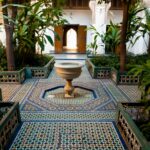
6. Courtyard Architecture (Patios & Riads)
Central to climate adaptation and spiritual orientation.
Includes fountains, gardens, and arcaded galleries.
7. Rammed Earth Walls (Pisè or Tabout)
Traditional Amazigh construction material used for kasbahs, ramparts, and fortresses.
9. The Philosophy Behind Moorish Architecture
Beyond its aesthetics, Moorish architecture is built upon profound principles:
- Unity through geometry
- Harmony with nature
- Light as a spiritual medium
- Privacy and introspection
- Craftsmanship as a sacred act
Every element—tile, arch, inscription, lattice—is part of a holistic worldview that blends beauty, function, faith, and science.
Moorish architecture in Morocco is not merely a historical style—it is a living heritage.
It reflects centuries of cultural exchange between Amazigh, Arab, Andalusian, and African civilizations, shaped by dynasties whose artistic vision left a timeless imprint.
From the spiritual serenity of the mosques of Fes and Marrakesh to the majestic kasbahs of the Atlas and the refined palaces of Meknes, this architectural tradition continues to define the Moroccan identity and inspire millions around the world.