A collection of stories, cultures and encounters waiting to be experienced.
Morocco is more than a destination.
It is not simply a country to visit, a list of cities to photograph, or a collection of monuments to check off a travel itinerary.
Morocco is an experience.
It is a country that reveals itself gradually — through its architecture, its landscapes, its craftsmanship, its food, its art, its music, its traditions and, above all, through its people.
To understand Morocco, one must look beyond the surface.
The beauty of Morocco is immediately visible: the colours of Marrakech, the blue streets of Chefchaouen, the architecture of Fes, the Atlantic light of Essaouira, the mountains of the Atlas, the vastness of the desert and the extraordinary craftsmanship found throughout the country.
But these are only the beginning.
Behind every colour, material, building, tradition and landscape is a story.
And it is these stories that make Morocco truly extraordinary.
1. MOROCCO IS A COUNTRY OF LAYERS
Perhaps the best way to understand Morocco is to think of it as a country of layers.
Geographically, Morocco moves from the Atlantic and Mediterranean coasts to fertile plains, ancient cities, mountains, valleys, oases and the Sahara.
Culturally, it is equally diverse.
Amazigh heritage, Arab culture, Islamic traditions, Andalusian influences, Jewish heritage, African connections, Mediterranean exchange and centuries of interaction with Europe have all contributed to the country’s identity.
These influences did not simply exist next to one another.
They interacted.
They influenced architecture, language, music, food, craftsmanship, urban planning and everyday life.
This is why Morocco cannot easily be reduced to a single identity or aesthetic.
There is no single “Moroccan style.”
There are many Moroccos.
The Morocco of the imperial cities is different from the Morocco of the High Atlas.
The culture of an Amazigh village is different from the traditions of an ancient medina.
The architecture of a Saharan kasbah is different from that of a Marrakech riad.
The contemporary art scene of Marrakech is different from the craftsmanship traditions of a rural community.
Yet all of these worlds belong to the same cultural landscape.
This diversity is one of Morocco’s greatest strengths.
2. BEYOND TOURISM: THE DIFFERENCE BETWEEN SEEING AND EXPERIENCING
There is an important difference between seeing a place and experiencing it.
A visitor may see a beautiful riad.
A traveller who understands architecture begins to ask:
Why is the building organized around a courtyard?
Why are the exterior walls so discreet?
Why is the interior so rich?
Why is water placed at the centre?
Why are rooms oriented inward?
Why do traditional materials perform both decorative and climatic functions?
These questions transform the experience.
The building stops being simply beautiful.
It becomes intelligent.
The same principle applies everywhere in Morocco.
A visitor may see a piece of zellij and admire its colours.
But once we understand how the tiles are traditionally produced, cut by hand, assembled geometrically and transformed into complex compositions, the object becomes something much more profound.
We begin to see mathematics, craftsmanship, patience, tradition and cultural memory.
A visitor may taste a Moroccan dish.
But when that meal is prepared by a family, using recipes transmitted through generations, served in a particular setting and accompanied by stories about its ingredients and traditions, food becomes culture.
This is the difference between tourism and meaningful travel.
To see is to observe.
To experience is to understand.
3. MOROCCO IS A STORYTELLER
Morocco is a country of stories.
Stories are embedded in its cities.
They are found in old doors, narrow streets, fountains, courtyards, markets, mosques, palaces, kasbahs and houses.
They are also found in objects.
A carpet can tell the story of a community.
A piece of jewellery can communicate identity.
A textile can reveal geography and tradition.
A ceramic object can demonstrate centuries of technical knowledge.
A building can tell us how people lived, what they valued and how they responded to their environment.
Architecture therefore becomes more than construction.
It becomes a form of cultural memory.
The old medinas are not simply beautiful historic environments.
They are living archives.
Their streets reflect social structures.
Their neighbourhoods reveal relationships between communities.
Their houses reveal ideas about privacy and family.
Their markets reveal systems of trade and craftsmanship.
Their fountains reveal the importance of water.
Their religious buildings reveal spiritual and intellectual traditions.
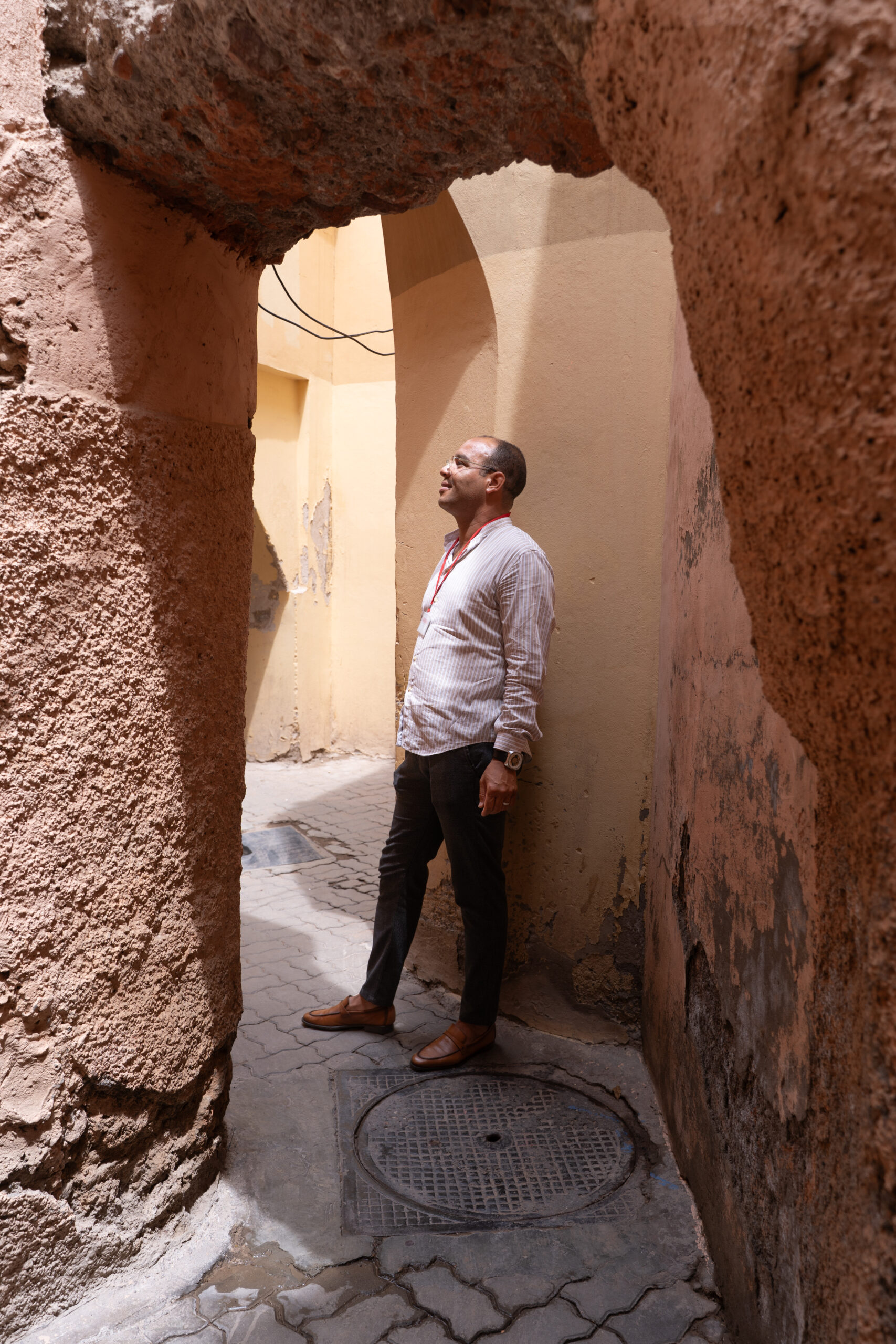
When we walk through an old Moroccan city, we are therefore walking through layers of history.
4. THE HUMAN SIDE OF MOROCCO
But architecture and history alone cannot explain Morocco.
The human experience is fundamental.
One of the country’s greatest treasures is its culture of hospitality.
Moroccan hospitality is not simply a service offered to visitors.
It is deeply connected to social and cultural traditions.
A cup of mint tea can become an invitation to conversation.
A meal can become an opportunity to share.
A visit to a workshop can become a meeting between two worlds.
A conversation with a craftsman can reveal knowledge that no textbook can completely communicate.
This is why encounters matter.
The most memorable moment of a journey may not necessarily be the most famous monument.
It may be a conversation with someone you met unexpectedly.
It may be watching a craftsman work with his hands.
It may be sitting in a courtyard in the late afternoon.
It may be sharing a meal with a family.
It may be discovering a small workshop hidden inside the medina.
These moments are difficult to photograph.
But they are often the moments people remember longest.
5. MOROCCO THROUGH ARCHITECTURE
Architecture provides one of the most powerful ways to understand Morocco.
The country’s architecture is not simply about decoration.
It is about climate, geography, religion, social organization, craftsmanship and identity.
In traditional Moroccan architecture, beauty and function are frequently inseparable.
A courtyard provides light and ventilation.
Thick walls help moderate temperature.
Small exterior openings provide privacy and protection from the intense climate.
Water introduces cooling and sensory relief.
Zellij creates extraordinary visual compositions while being part of a larger architectural system.
Tadelakt provides a practical waterproof surface while becoming an aesthetic element.
Carved cedar brings warmth and craftsmanship to interiors.
Stucco creates intricate surfaces that transform light throughout the day.
Architecture becomes a dialogue between necessity and beauty.
This is one of the reasons Moroccan architecture remains so relevant to contemporary designers.
It offers lessons about sustainability, climate responsiveness, materiality, proportion, privacy and sensory experience — long before these became contemporary architectural concerns.
6. THE RIAD: AN ARCHITECTURE OF PRIVACY AND INNER LIFE
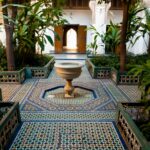
The Moroccan riad is perhaps one of the clearest examples of this philosophy.
From the outside, a traditional house can appear almost anonymous.
The street may offer very little indication of what exists behind the entrance.
But once inside, the experience changes completely.
The house turns inward.
At its centre is the courtyard.
This courtyard becomes the heart of the home.
It can bring light, air, greenery and water into the building.
It creates a private world protected from the intensity of the street.
This inward orientation reflects something much deeper than architectural technique.
It reflects ideas about family, privacy, hospitality and domestic life.
The most important spaces are often not presented to the outside world.
They are discovered from within.
This creates one of the most fascinating characteristics of Moroccan architecture:
The exterior can be restrained while the interior becomes extraordinary.
The architecture teaches us something about Moroccan culture itself — that what is most valuable does not always need to be displayed from the outside.
7. AMAZIGH HERITAGE: ARCHITECTURE OF PLACE
To understand Morocco, we must also understand its Amazigh heritage.
Amazigh culture is deeply connected to the land.
Its architecture developed in response to mountains, valleys, deserts, climate, available materials and community structures.
In the Atlas and southern regions, earthen architecture demonstrates an extraordinary understanding of local resources.
Earth, stone, timber and other natural materials become architecture.
Kasbahs and ksour emerge from their environment rather than appearing completely separate from it.
Walls provide protection.
Massive earthen construction provides thermal stability.
Compact settlements reduce exposure to extreme temperatures.
Architecture becomes an adaptation to place.
This is an important lesson for contemporary architecture.
Before the language of “sustainable design” became widespread, vernacular architecture was already using local materials, passive climatic strategies and collective knowledge developed over generations.
8. CRAFTSMANSHIP: WHERE ART BECOMES EVERYDAY LIFE
One of the extraordinary characteristics of Morocco is that art is not confined to museums.
It lives within everyday life.
A door can be a work of art.
A wall can become a composition.
A fountain can become sculpture.
A carpet can become an expression of identity.
A ceramic plate can contain centuries of technical knowledge.
A piece of zellij can transform architecture into geometry.
Craftsmanship is therefore not simply decoration.
It is a form of knowledge.
The Maâlem — the master craftsman — represents a tradition in which knowledge is often transmitted through practice.
The apprentice watches.
The apprentice repeats.
The apprentice makes mistakes.
The apprentice develops sensitivity to the material.
Over time, technique becomes intuition.
This is something that cannot easily be learned from a book.
It is embodied knowledge.
Hands remember what words cannot always explain.
9. ZELLIJ: GEOMETRY, PATIENCE AND CULTURAL MEMORY
Moroccan zellij is a particularly powerful example.
At first glance, one might simply see colourful geometric tiles.
But behind this apparent simplicity is an extraordinary intellectual and technical system.
The craftsman begins with a material.
The material is transformed.
The tile is cut into precise shapes.
Those shapes are assembled according to geometric principles.
The individual pieces disappear into the larger composition.
The final result can appear effortless.
But the apparent simplicity is the result of enormous precision.
Zellij therefore exists somewhere between art, mathematics, architecture and craftsmanship.
It is not merely applied decoration.
It participates in the architectural identity of the space.
And today, its influence can be seen far beyond Morocco — in contemporary interiors, fashion, furniture, graphic design and international luxury design.
This demonstrates something important:
Moroccan heritage is not only something to preserve. It is also something capable of inspiring the future.
10. MOROCCO AND CONTEMPORARY CREATIVITY
Morocco is not frozen in the past.
This is essential to understand.
The country possesses an extraordinary heritage, but it also has a contemporary creative culture.
Artists, architects, designers, photographers, fashion designers and craftspeople are constantly reinterpreting Moroccan identity.
They work with traditional materials while introducing contemporary forms.
They reinterpret traditional patterns.
They transform old techniques into modern objects.
They combine international influences with local knowledge.
Marrakech in particular has become an important meeting point between Moroccan heritage and international creativity.
Here, tradition and contemporary design can exist within the same neighbourhood.
A centuries-old architectural vocabulary can inspire a contemporary interior.
A traditional craft technique can become a modern design object.
A Moroccan pattern can enter the language of international fashion.
This relationship between heritage and contemporary creativity is one of the most exciting aspects of Morocco today.
11. FOOD AS CULTURAL MEMORY
Morocco must also be understood through food.
Food is one of the most intimate ways to enter a culture.
Moroccan cuisine is not simply about flavour.
It is about memory.
Recipes are transmitted through families.
Techniques are learned at home.
Ingredients reflect geography.
Spices reflect history and trade.
Meals reflect hospitality and social relationships.
The tagine is not merely a dish.
It represents a method of cooking.
Couscous is not simply food.
It is connected to Amazigh and North African cultural traditions and to the social ritual of sharing.
Bread has its own place within everyday Moroccan life.
Mint tea is more than a beverage.
It is part of the ritual of welcoming.
When you understand these traditions, a meal becomes a cultural experience.
12. THE IMPORTANCE OF SLOW TRAVEL
Perhaps one of the most valuable ways to discover Morocco is to slow down.
Morocco rewards curiosity.
Instead of rushing from monument to monument, take time to observe.
Look at the craftsmanship.
Listen to the sounds.
Notice the light.
Watch how people use public spaces.
Observe the relationship between buildings and streets.
Enter a workshop.
Speak to a local person.
Taste something unfamiliar.
Ask questions.
Take a different street.
Allow yourself to become slightly lost.
Because sometimes the most interesting discoveries are not planned.
They happen between the places listed on the itinerary.
This is where travel becomes personal.
13. THE ART OF THE ENCOUNTER
Travel is ultimately about encounters.
An encounter with a place.
An encounter with a culture.
An encounter with an idea.
An encounter with another person.
And sometimes, an encounter with ourselves.
Morocco has an extraordinary ability to create these encounters because its cultural life remains deeply connected to everyday experience.
A market is not a museum.
A medina is not a historical reconstruction.
A workshop is not a theatre.
A family meal is not simply a restaurant experience.
These are living environments.
And when we approach them with curiosity and respect, we can experience something much more authentic.
14. BEYOND THE POSTCARD
There is, of course, a Morocco that everyone knows.
The famous photographs.
The colourful souks.
The desert camps.
The blue city.
The red walls of Marrakech.
The Atlas Mountains.
The traditional riads.
All of these are beautiful.
But Morocco becomes much more interesting when we go beyond the postcard.
What happens behind the famous door?
Who made the object?
Why was the building designed this way?
What does the pattern mean?
How does the family use the house?
Where did the craft originate?
How has the city changed?
What is happening in Moroccan contemporary art?
How are young designers reinterpreting tradition?
These questions open another Morocco.
A deeper Morocco.
A Morocco that is not immediately visible.
15. MOROCCO AS INSPIRATION
For artists, architects, designers and creative people, Morocco can be particularly powerful.
The country offers an extraordinary vocabulary of colour, texture, geometry, light and material.
Terracotta.
Ochre.
Cobalt blue.
Emerald green.
Natural earth.
Brass.
Wood.
Stone.
Ceramic.
Leather.
Textile.
Plaster.
Each material has its own character.
Each region has its own palette.
Each craft has its own language.
And light constantly transforms these elements.
Morning light on a medina wall is different from the intense light of midday.
The warm evening light changes the perception of architecture.
Inside a riad, light becomes softer and more controlled.
In the desert, the relationship between light and landscape becomes almost abstract.
For a creative traveller, Morocco can therefore become a living studio.
You are not simply looking at design.
You are surrounded by it.
16. THE MOROCCO OF CONTRASTS
Another reason Morocco is so fascinating is its contrasts.
Old and new.
Urban and rural.
Traditional and contemporary.
Public and private.
Light and shadow.
Colour and simplicity.
Luxury and craftsmanship.
Mountains and desert.
Atlantic and Mediterranean.
These contrasts create a dynamic cultural landscape.
Morocco does not always resolve these opposites.
Instead, it allows them to coexist.
A centuries-old riad can contain contemporary furniture.
A traditional craft can inspire modern fashion.
An ancient medina can exist beside a modern city.
A historic building can become a contemporary cultural space.
This dialogue between past and present is one of the defining characteristics of modern Morocco.
17. TRAVEL AS A FORM OF DISCOVERY
A journey through Morocco should therefore be more than an itinerary.
It should be a process of discovery.
The destination matters, but the way we experience the destination matters even more.
Two people can visit exactly the same city and return with completely different experiences.
One person may remember monuments.
Another may remember a conversation.
Another may remember a meal.
Another may remember the texture of a wall.
Another may remember the light inside a courtyard.
Another may return home inspired by a colour, a pattern, an architectural detail or a craft technique.
This is what makes travel personal.
There is no single Morocco.
There is the Morocco each traveller discovers.
18. WHY ENCOUNTERS MATTER
The word “encounter” is particularly important.
An encounter is different from an attraction.
An attraction is something we go to see.
An encounter is something that involves us.
It creates a relationship.
Meeting an artist allows us to understand creativity from the perspective of the person creating it.
Meeting a craftsman allows us to understand the discipline behind an object.
Meeting a local family allows us to experience hospitality rather than simply read about it.
Walking through a neighbourhood with someone who knows its history allows us to see details that we might otherwise miss.
These encounters transform information into experience.
And experience is what remains.
19. A DIFFERENT PHILOSOPHY OF TRAVEL
This is the philosophy behind a different way of travelling through Morocco.
It is not about seeing everything.
It is about seeing more deeply.
It is not about rushing through a checklist.
It is about creating meaningful moments.
It is not about simply photographing architecture.
It is about understanding it.
It is not about simply buying craftsmanship.
It is about discovering the people and knowledge behind it.
It is not about simply visiting galleries.
It is about understanding the artistic landscape of contemporary Morocco.
It is not about simply eating Moroccan food.
It is about understanding the culture of hospitality and sharing behind it.
This approach creates a richer relationship between traveller and destination.
20. MOROCCO THROUGH ART, ARCHITECTURE AND DESIGN
For me, art, architecture and design offer three particularly powerful doors into Morocco.
Art allows us to understand how Morocco sees itself.
Contemporary artists often explore identity, memory, landscape, history and social change.
Architecture allows us to understand how Morocco lives.
The organization of houses, streets, courtyards and cities reveals values, climate responses and social structures.
Design allows us to understand how Morocco transforms tradition into contemporary expression.
Craftsmanship, materials, patterns and techniques continue to inspire new generations.
Together, these three perspectives create a much richer understanding of the country.
They allow us to move beyond conventional tourism and into the cultural and creative soul of Morocco.
21. THE MOROCCO I BELIEVE IS WORTH SHARING
Morocco does not need to be presented as exotic.
It does not need to be romanticized.
Its richness is already there.
What it needs is to be understood.
To look at Morocco with curiosity rather than simply expectation.
To respect its traditions while recognizing its contemporary creativity.
To appreciate its beauty while also understanding the intelligence behind it.
To meet people rather than simply consume experiences.
To discover the country through different perspectives.
This is the Morocco that deserves to be experienced.
22. THE JOURNEY CONTINUES AFTER YOU LEAVE
Perhaps the most beautiful thing about travel is that the journey does not necessarily end when you return home.
A successful journey changes the way you see.
You return with new references.
A new appreciation of craftsmanship.
A different understanding of architecture.
A memory of a conversation.
A flavour.
A colour.
A sound.
A landscape.
An idea.
Perhaps you begin to see your own surroundings differently.
Perhaps a Moroccan courtyard influences the way you think about space.
Perhaps a piece of craftsmanship inspires a design.
Perhaps a conversation changes your understanding of another culture.
This is when travel becomes more than tourism.
It becomes part of your personal history.
CONCLUSION
Morocco is more than a destination.
It is a living cultural landscape.
It is a country where history is still present in everyday life, where craftsmanship continues to be practiced by hand, where architecture carries the memory of generations, where food becomes a language of hospitality, and where contemporary artists and designers continue to reinterpret an extraordinarily rich heritage.
It is a country of contrasts, encounters and discoveries.
A place where the past and present constantly speak to one another.
And perhaps most importantly, Morocco invites us to look closer.
Behind the door is another space.
Behind the pattern is a story.
Behind the building is a way of life.
Behind the object is a craftsman.
Behind the meal is a tradition.
Behind the city is history.
And behind every encounter is the possibility of discovering something we did not expect.
This is why Morocco should not simply be visited.
It should be experienced.
Because the most meaningful journeys are not measured by the number of places we have seen.
They are measured by the depth of what we have felt, understood and discovered.
Morocco is more than somewhere you go.
It is somewhere you connect with.
Somewhere you learn from.
Somewhere you become inspired by.
And, ultimately, somewhere that becomes part of your own story.