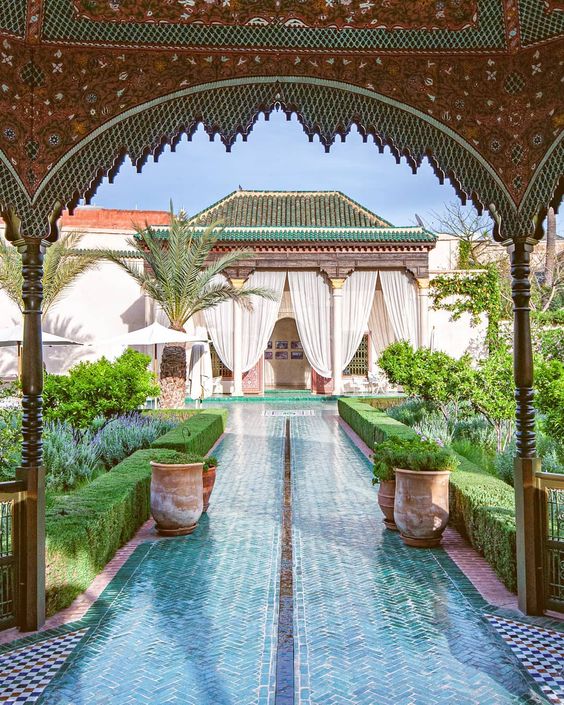
Islamic gardens represent one of the most refined and symbolic expressions of architecture and landscape design in the Islamic world. More than ornamental spaces, they are deeply philosophical environments shaped by spiritual ideals, scientific knowledge, and cultural traditions that have evolved over centuries, from Persia and Al-Andalus to North Africa and the Ottoman world. Rooted in the Quranic vision of paradise, the Islamic garden is conceived as a place of harmony, contemplation, and balance between humanity, nature, and the divine.
Philosophical and Spiritual Foundations
The concept of the Islamic garden is inseparable from the idea of Jannah (Paradise), repeatedly described in the Quran as gardens beneath which rivers flow. Water, shade, greenery, and fragrance are not merely aesthetic elements; they symbolize life, purity, eternity, and divine generosity. The garden is designed as a microcosm of the universe, reflecting cosmic order and spiritual equilibrium. Geometry, symmetry, and proportion play a central role, reinforcing the idea that beauty emerges from order and balance, principles fundamental to Islamic thought.
Architectural Structure and Spatial Organization
At the heart of Islamic garden design lies the Chahar Bagh layout, a quadripartite plan divided into four sections by water channels or pathways, symbolizing the four rivers of paradise—water, milk, honey, and wine. This structured geometry creates a sense of calm and orientation while guiding movement and visual perspective. Central fountains, pavilions, or reflective pools act as focal points, anchoring the space both visually and spiritually.
Architectural elements such as arcades, colonnades, shaded walkways, and garden pavilions are carefully integrated into the landscape. These structures blur the boundary between built form and nature, allowing architecture to frame views, regulate climate, and enhance sensory experience. In regions such as Morocco and Al-Andalus, gardens are often enclosed by walls, creating an inward-looking sanctuary that protects privacy and reinforces the contemplative nature of the space.
Water as a Structural and Symbolic Element
Water is the defining feature of Islamic gardens, both structurally and symbolically. Ingenious hydraulic systems—canals, underground khettaras, basins, and gravity-fed fountains—demonstrate advanced engineering knowledge developed in arid environments. Flowing water cools the air, reflects architecture and vegetation, and introduces sound, movement, and light into the garden.
Symbolically, water represents divine mercy, purification, and continuity of life. Its controlled movement through linear channels and geometric basins mirrors the Islamic worldview of harmony between natural forces and human intellect. The reflective quality of water further enhances the sense of infinity and spiritual depth.
Vegetation, Fragrance, and Sensory Design
Plant selection in Islamic gardens is deliberate and symbolic. Fruit trees such as orange, pomegranate, fig, and date palm provide shade, nourishment, and seasonal change, while flowering plants—jasmine, rose, iris, and orange blossom—introduce fragrance and color. The garden is designed as a multisensory experience, engaging sight, sound, scent, and touch.
The interplay between evergreen and deciduous plants ensures year-round vitality, while carefully maintained proportions prevent excess or disorder. Nature is not left wild; it is cultivated with respect, reflecting the Islamic principle of stewardship (khilafah) over the earth.
Regional Expressions and Cultural Adaptations
While unified by shared principles, Islamic gardens vary significantly across regions. Persian gardens emphasize axial symmetry and monumental scale; Andalusian and Moroccan gardens favor intimacy, enclosed courtyards, and intricate surface decoration. In Morocco, riads and palace gardens integrate zellij tilework, carved stucco, cedarwood ceilings, and marble basins, creating a refined dialogue between architecture, craftsmanship, and landscape.
Historic examples such as the Generalife in Granada, the Agdal and Menara Gardens in Marrakech, and the Persian gardens of Shiraz and Isfahan stand as enduring testaments to this sophisticated design tradition.
Heritage, Preservation, and Contemporary Relevance
Islamic gardens are living heritage sites, reflecting centuries of cultural exchange, environmental adaptation, and artistic excellence. Today, they continue to inspire contemporary landscape architecture, sustainable design, and wellness spaces worldwide. Their emphasis on water management, climate responsiveness, and human-scale design offers valuable lessons for modern urban environments facing ecological challenges.
Preserving Islamic gardens is not merely an act of conservation but a commitment to safeguarding intangible values—spirituality, craftsmanship, knowledge transmission, and cultural identity. They remain places of reflection, beauty, and connection, where architecture and nature coexist in timeless harmony.