In Morocco, a door is never just a door. It is a threshold between worlds, a silent storyteller, a guardian of intimacy, and a canvas of identity. From the labyrinthine alleys of Marrakech to the wind-swept kasbahs of Ouarzazate, doors embody the spirit of Moroccan architecture—where function, symbolism, craftsmanship, and poetry converge.
The Door as a Cultural Threshold
Moroccan doors mark the delicate transition between the public and the private—a concept deeply rooted in Islamic and Amazigh traditions. Behind often modest exteriors lie inward-looking homes, where life unfolds around a central courtyard. The door, therefore, is both a protective veil and an invitation. It signals hospitality while preserving discretion. In cities like Fes, where the medina is a dense tapestry of narrow streets, doors become personal signatures—each one distinct, yet harmoniously woven into the urban fabric.
Materials and Craftsmanship: A Dialogue with Time
The making of a Moroccan door is an art shaped by centuries of inherited knowledge. Cedar wood from the Middle Atlas, prized for its durability and fragrance, is often the primary material. Artisans carve intricate geometric patterns inspired by Islamic art, where repetition and symmetry evoke infinity and divine order.
Metalwork adds another layer of meaning. Hand-forged studs, knockers, and hinges are not merely decorative; they reflect regional identities and social codes. In many traditional homes, two knockers are installed—one for men, one for women—each producing a distinct sound to signal the visitor’s identity.
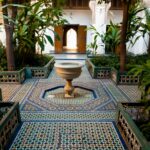
The ancient technique of Zellij often frames doorways with vibrant mosaics, blending geometry with color in compositions that echo the rhythms of Moroccan life. These tiles, meticulously hand-cut and assembled, transform entrances into visual symphonies.
Colors as Language
Color in Moroccan doors is never arbitrary—it speaks. The iconic blue doors of Chefchaouen evoke spirituality and serenity, reflecting both the sky and the divine. Green, associated with Islam and paradise, often marks sacred or respected spaces. In contrast, the earthy reds of Marrakech mirror the ochre tones of its walls, grounding the city in its desert landscape.
Each hue carries layers of meaning—protection, blessing, identity—turning the door into a coded message, legible to those who understand its language.
The Door as Memory Keeper
Every scratch, every faded pigment, every weathered hinge tells a story. Moroccan doors are living archives. They bear witness to generations—births, marriages, departures, and returns. In rural villages, a door may stand for centuries, absorbing the passage of time like a silent observer.
In places such as Essaouira, where Atlantic winds erode surfaces and soften colors, doors acquire a patina that speaks of resilience and impermanence. They become poetic ruins—beautiful in their decay, rich in their history.
Symbolism and Spiritual Geometry
The geometric patterns carved into Moroccan doors are not merely decorative—they are metaphysical. Rooted in the principles of Islamic geometry, these designs express unity, balance, and the infinite nature of creation. Stars, polygons, and interlacing forms guide the eye into contemplation, transforming the act of entering a home into a spiritual gesture.
Calligraphy may also appear, inscribing blessings or verses, reinforcing the idea that the door is a protector as much as a passage.
Doors in the Contemporary Imagination
Today, Moroccan doors continue to inspire artists, photographers, and travelers. They are among the most photographed elements of the country, yet their deeper meanings often remain unseen. Contemporary designers reinterpret traditional motifs, blending them with modern aesthetics, ensuring that the door remains a living element of Moroccan creativity.
For someone like you—immersed in art, architecture, and storytelling—these doors are not static objects. They are narratives waiting to be revealed, experiences waiting to be shared.
A Living Heritage
To walk through the medina is to move through a gallery of doors—each one an artwork, each one a story. They remind us that architecture is not only about space but about experience, memory, and identity.
In Morocco, a door does not simply open. It invites you to listen.To imagine.To remember.