Among the greatest artistic and architectural achievements of the Islamic world, Moroccan Zellige stands as one of the most intellectually sophisticated and visually captivating forms of craftsmanship ever created. Neither merely decorative nor purely functional, Zellige is a complete architectural philosophy — a discipline where geometry, spirituality, mathematics, materiality, light, and human craftsmanship merge into a timeless visual language. For architects, interior designers, collectors, historians, and art lovers, Moroccan Zellige represents far more than handcrafted tilework; it embodies the cultural memory and artistic soul of Morocco itself.
For centuries, the art of Zellige has shaped the identity of Moroccan architecture. From the imperial cities of Fez, Marrakech, Meknes, and Rabat to ancient madrasas, palaces, riads, fountains, hammams, and mosques, Zellige has remained one of the most essential elements defining Moroccan spatial aesthetics. Its presence transforms architecture into an immersive sensory experience where surfaces become rhythmic compositions of light, texture, color, reflection, and sacred geometry.
The origins of Moroccan Zellige are deeply connected to the artistic exchange between Amazigh traditions, Andalusian aesthetics, Arab-Islamic geometry, and Mediterranean craftsmanship. Following the migration of Andalusian artisans into Morocco after the fall of Al-Andalus, Morocco became one of the most important centers for geometric decorative arts. Over centuries, Moroccan master craftsmen elevated Zellige into an extraordinary architectural science, reaching remarkable refinement during the Almoravid, Almohad, Marinid, Saadian, and Alaouite dynasties. The result was the creation of an artistic language unique to Morocco — a language capable of transforming architecture into a spiritual and mathematical masterpiece.
At the heart of Moroccan Zellige lies the philosophy of geometry. In Islamic artistic traditions, geometry symbolizes the infinite nature of creation and the divine order of the universe. Every star, polygon, interlacing line, and tessellated composition reflects a cosmic balance between repetition and infinity. Moroccan artisans understood geometry not simply as ornamentation, but as a metaphysical expression of harmony, unity, and intellectual beauty.
The extraordinary complexity of Zellige patterns reveals an advanced understanding of mathematics long before the emergence of modern computational design. Through purely manual techniques, Moroccan artisans mastered proportional systems capable of generating infinitely repeating geometric compositions with astonishing precision. Eight-pointed stars, twelve-pointed rosettes, complex polygons, and interwoven networks create visual movement that appears almost alive. The eye continuously travels across the surface, discovering endless relationships between rhythm, symmetry, fragmentation, and balance.
Unlike industrial ceramic production, authentic Moroccan Zellige is entirely handmade through an extraordinarily labor-intensive process that has remained almost unchanged for centuries. The clay traditionally comes from the Fez region, where the mineral composition provides exceptional density and durability. The clay is first soaked, purified, kneaded, and hand-shaped before being naturally dried under the sun. Each tile is then kiln-fired using traditional techniques that preserve the organic character of the material.
The glazing process itself is an art of chemistry and mineral pigmentation. Traditional colors carry both historical and symbolic significance. Deep cobalt blue evokes spirituality and infinity. Emerald green symbolizes paradise and nature. White reflects purity and light. Ochre and honey tones recall the Moroccan earth and desert landscapes. Black introduces visual depth and contrast. Over centuries, artisans developed sophisticated glazing methods capable of producing extraordinary luminosity and subtle chromatic variations impossible to replicate industrially.
Perhaps the most remarkable aspect of Moroccan Zellige is the cutting process. After glazing and firing, each tile is individually hand-cut using a sharp hammer called the menqach. This demanding technique requires years — often decades — of training. The master artisan, known as the Maâlem, cuts geometric fragments entirely by hand without relying on automated machinery. Every tiny piece must fit perfectly into larger compositions assembled like architectural puzzles.
This process transforms the artisan into both mathematician and sculptor. The Maâlem does not merely execute decoration; he constructs geometry manually through intuition, memory, rhythm, and inherited knowledge. Every composition becomes a physical manifestation of intellectual precision and human sensitivity.
One of the most extraordinary qualities of authentic Moroccan Zellige lies in its imperfections. Unlike industrial ceramics designed for uniformity, handcrafted Zellige embraces subtle irregularities. Slight tonal variations, handcrafted edges, nuanced reflections, and delicate asymmetries create surfaces filled with life and movement. As sunlight changes throughout the day, Zellige transforms continuously — reflecting, absorbing, and diffusing light in endlessly dynamic ways.
This living quality explains why Zellige has become increasingly admired in contemporary luxury architecture and interior design. In a world dominated by synthetic materials and digital uniformity, architects and designers are returning to artisanal materials that possess authenticity, tactility, and emotional resonance. Moroccan Zellige introduces depth and humanity into modern spaces. It creates interiors that feel timeless rather than temporary.
Within traditional Moroccan architecture, Zellige was never isolated from other crafts. It formed part of a complete artistic ecosystem integrating carved cedar wood, sculpted plaster, tadelakt walls, marble fountains, and hand-forged metalwork. Moroccan architecture is based on the concept of total harmony, where every material contributes to a unified sensory and spiritual environment.
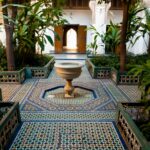
In riads and palaces, Zellige often appears alongside water — another central symbol in Islamic architecture. Reflective tile surfaces amplify the movement of water and light, creating atmospheres of tranquility and contemplation. Courtyards become sanctuaries of silence and beauty where architecture dissolves the boundary between material and spiritual experience.
Moroccan Zellige also possesses remarkable environmental intelligence. Long before sustainable design became a contemporary concern, traditional Moroccan architecture integrated passive cooling strategies through materials and spatial composition. Zellige surfaces help regulate temperature, resist humidity, and reflect light naturally, contributing to thermal comfort in warm climates. This ecological intelligence demonstrates the deep relationship between Moroccan craftsmanship and environmental adaptation.
Today, Moroccan Zellige occupies a unique position within global design culture. International architects, interior designers, collectors, and luxury hospitality brands increasingly seek authentic Moroccan craftsmanship for its emotional richness and historical depth. Contemporary applications of Zellige now extend far beyond traditional architecture. Minimalist interiors, luxury boutiques, contemporary spas, boutique hotels, artistic installations, and modern residences integrate Zellige as both architectural surface and sculptural element.
Its versatility allows it to dialogue beautifully with contemporary materials such as concrete, steel, glass, brass, and natural stone. In modern architecture, Zellige often becomes a bridge between tradition and innovation — introducing warmth, texture, and cultural memory into clean contemporary spaces.
For architects and designers, Moroccan Zellige offers more than aesthetic beauty. It represents a philosophy of making. It reminds contemporary design culture that craftsmanship is not separate from architecture but fundamental to it. Every handcrafted tile contains time, gesture, discipline, and human presence. In an age increasingly shaped by automation and artificial production, Zellige preserves the value of patience, mastery, and ancestral knowledge.
For art lovers and collectors, Zellige is a form of living heritage. It carries centuries of cultural exchange, mathematical intelligence, spiritual symbolism, and artistic refinement. Every composition reflects Morocco’s role as a crossroads of civilizations — African, Amazigh, Arab, Andalusian, Mediterranean, and Islamic influences converging into a singular artistic identity.
The beauty of Moroccan Zellige lies not only in what it decorates, but in what it represents: balance within complexity, harmony within fragmentation, permanence within change, and spirituality within material form. It transforms architecture into emotion and craftsmanship into philosophy.
Moroccan Zellige is ultimately one of the most powerful expressions of human creativity ever embedded into architecture. It is not simply a tile tradition. It is a sacred geometry of light and clay, a timeless dialogue between mathematics and poetry, and one of Morocco’s greatest artistic treasures.