Throughout the history of Moroccan architecture, no element embodies the country’s architectural philosophy more profoundly than the riad and its interior courtyard. More than a house, the riad is a carefully orchestrated dialogue between architecture, nature, spirituality, climate, and human life. It represents centuries of accumulated knowledge, where beauty is never separated from purpose and every architectural decision serves both practical and symbolic functions.
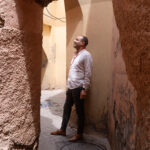
Unlike many Western architectural traditions that celebrate monumental façades and outward expression, the Moroccan riad follows a fundamentally different philosophy. Its exterior walls are intentionally modest, often plain and almost anonymous. Behind these discreet facades, however, lies an extraordinary world of light, water, gardens, craftsmanship, and refined decoration. This architectural contrast expresses one of the deepest principles of Moroccan culture: true beauty is discovered within rather than displayed outwardly.
The Meaning of “Riad”
The word Riad originates from the Arabic word Riyad, meaning garden. Historically, the garden is not merely an ornamental feature but the very heart of the home. Inspired by Islamic descriptions of paradise as gardens beneath which rivers flow, Moroccan architects transformed this spiritual vision into domestic architecture.
The central courtyard became a symbolic paradise—a peaceful sanctuary where nature, water, fragrance, and architecture coexist in perfect harmony. Living inside a riad is therefore not simply inhabiting a building; it is living around a carefully composed landscape that nurtures both body and soul.
Every room of the house looks inward toward this protected garden, reinforcing the idea that the true center of life is found in calmness rather than spectacle.
An Architecture Designed from the Inside Out
One of the greatest distinctions between Moroccan architecture and much of European architecture lies in its orientation.
Western houses traditionally emphasize the street façade, with windows overlooking public spaces and architecture communicating status to the outside world.
Moroccan architecture reverses this principle entirely.
The riad is conceived from the inside outward. The courtyard becomes the architectural nucleus around which every room, gallery, staircase, and living space is organized.
This inward orientation creates:
- Complete visual privacy
- Continuous natural light
- Controlled ventilation
- Acoustic serenity
- Strong family cohesion
Rather than interacting constantly with the surrounding city, the inhabitants experience a protected microcosm where architecture filters noise, heat, and distraction.
This concept perfectly reflects Moroccan notions of hospitality, intimacy, and domestic life.
Climatic Intelligence: Architecture Before Air Conditioning
Long before modern technology, Moroccan builders developed sophisticated passive cooling systems perfectly adapted to North Africa’s climate.
The courtyard functions as a natural environmental regulator.
During the day:
- Thick rammed-earth or masonry walls absorb heat slowly.
- Narrow exterior openings minimize solar gain.
- Trees provide natural shade.
- Water from the fountain cools the surrounding air through evaporation.
As evening arrives, the accumulated heat escapes upward through the open courtyard while cooler night air naturally circulates throughout the house.
This continuous cycle creates a remarkably comfortable indoor climate, often reducing temperatures by several degrees without any mechanical intervention.
The courtyard therefore operates as a natural air-conditioning system centuries before sustainable architecture became a modern discipline.
Today, many contemporary architects admire Moroccan riads as exceptional examples of bioclimatic architecture.
The Fountain: The Soul of the Courtyard
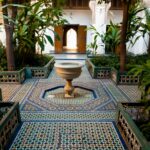
At the center of most traditional riads stands a fountain.
Its presence is never accidental.
Water carries profound symbolic significance throughout Moroccan and Islamic culture.
It represents:
- Purity
- Life
- Spiritual renewal
- Abundance
- Paradise
Beyond symbolism, the gentle sound of flowing water softens urban noise and introduces a constant atmosphere of tranquility.
Architecturally, the fountain also contributes to cooling the surrounding air while visually anchoring the perfect symmetry of the courtyard.
The experience becomes multisensory:
You hear the water.
You feel the cooler air.
You smell orange blossoms or jasmine.
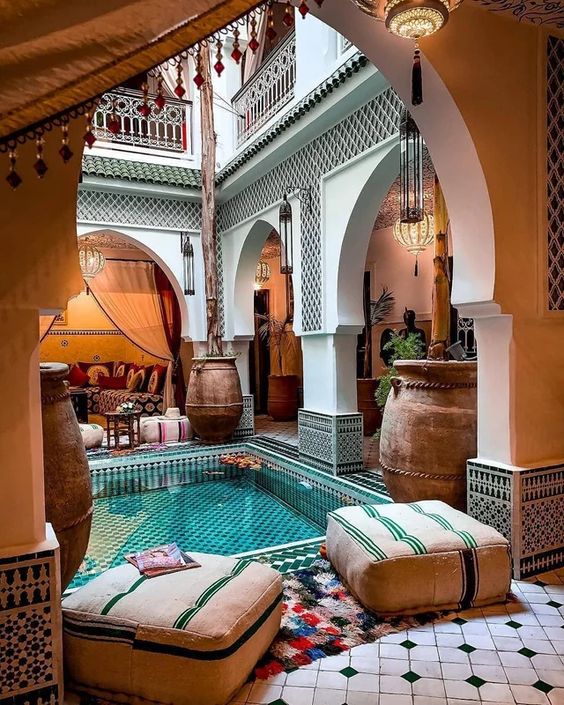
You see reflections dancing across handcrafted zellij tiles.
The courtyard becomes an immersive environment where architecture appeals equally to every sense.
Geometry and Harmony
Nothing within a traditional Moroccan courtyard is random.
Its proportions are based upon carefully balanced geometric relationships inherited from Andalusian, Islamic, Amazigh (Berber), and Mediterranean traditions.
Perfect symmetry creates visual stability.
The courtyard often follows a square or nearly square plan, with galleries arranged equally on all four sides.
This geometry reflects broader philosophical ideas about cosmic order and universal harmony.
The architecture quietly communicates balance without excess.
Rather than overwhelming the visitor, it invites contemplation.
Nature as an Architectural Material
Unlike many architectural traditions where vegetation is simply decoration, Moroccan riads integrate nature as an essential architectural component.
Typical courtyard gardens include:
- Orange trees
- Lemon trees
- Olive trees
- Palm trees
- Jasmine
- Roses
- Bougainvillea
- Aromatic herbs
These plants perform multiple roles simultaneously.
They provide shade.
They perfume the air.
They cool the microclimate.
They attract birds.
They soften the mineral architecture with organic life.
This intimate dialogue between vegetation and architecture transforms the courtyard into a living ecosystem rather than a static decorative space.
Privacy as an Architectural Principle
Privacy occupies a central place in Moroccan domestic architecture.
Rather than isolating inhabitants from one another, the riad protects family life from the outside world.
Windows rarely overlook public streets.
Instead, every principal room opens toward the internal courtyard.
This arrangement allows:
- Complete family interaction
- Natural surveillance of shared spaces
- Protection from external views
- Peaceful daily life
The architecture establishes a delicate balance between openness within the family and discretion toward the outside world.
This spatial organization reflects centuries of cultural values centered on dignity, hospitality, and domestic harmony.
The Courtyard as the Heart of Daily Life
Historically, nearly every aspect of domestic life revolved around the courtyard.
Families gathered here to:
- Share meals
- Welcome guests
- Celebrate religious festivals
- Tell stories
- Drink mint tea
- Listen to music
- Practice craftsmanship
- Allow children to play safely
Seasonal rhythms also shaped how the space was used.
Morning sunlight illuminated one side of the courtyard.
Afternoon shade naturally shifted around the galleries.
Evening transformed the courtyard into the coolest and most pleasant space within the home.
Rather than functioning merely as circulation space, the courtyard became the emotional heart of the household.
The Architecture of Light
Moroccan architecture demonstrates extraordinary mastery of natural light.
Because sunlight enters primarily through the open roof of the courtyard, it constantly changes throughout the day.
Morning light emphasizes carved plaster.
Afternoon light illuminates cedar wood.
Evening creates soft reflections across polished zellij.
Rather than flooding interiors uniformly, light is carefully moderated, producing depth, mystery, and changing atmospheres.
This subtle choreography transforms architecture into a living composition where no two moments appear exactly alike.
A Masterpiece of Moroccan Craftsmanship
The courtyard also serves as a showcase for Morocco’s greatest artistic traditions.
Every surface becomes an opportunity for craftsmanship.
The visitor encounters:
- Hand-cut Zellij mosaics with intricate geometric compositions
- Sculpted plaster (gebs) featuring delicate arabesques and calligraphy
- Carved cedar wood ceilings, balconies, and doors
- Traditional Tadelakt lime plaster polished to a silky finish
- Marble paving and fountains crafted by master stonemasons
- Forged iron lanterns and decorative metalwork
Each element is handcrafted by artisans whose knowledge has been transmitted across generations.
The result is not merely decoration but a harmonious integration of architecture, mathematics, craftsmanship, and cultural identity.
Contemporary Relevance
Today, the Moroccan riad continues to inspire architects, designers, and urban planners around the world.
In an era increasingly concerned with sustainability, well-being, and human-centered design, the traditional courtyard demonstrates timeless architectural intelligence.
Its passive cooling strategies reduce energy consumption.
Its emphasis on natural materials supports environmental sustainability.
Its inward orientation promotes tranquility in increasingly dense cities.
Its integration of vegetation improves air quality and mental well-being.
Perhaps most importantly, the riad reminds us that architecture is not only about constructing buildings—it is about creating environments that enrich everyday life.
A Timeless Architectural Legacy
The Moroccan courtyard is far more than a beautiful space; it is the embodiment of a sophisticated civilization that understood how architecture could harmonize climate, spirituality, craftsmanship, and human experience. Within its walls, every element—from the whisper of the fountain and the fragrance of orange blossoms to the intricate geometry of zellij and the play of sunlight across carved cedar—serves a purpose, creating an environment where comfort, beauty, and meaning are inseparable.
The riad stands as one of Morocco’s greatest architectural achievements because it transcends style. It is not simply a historic house but a timeless philosophy of living: one that values inner harmony over outward display, privacy over spectacle, nature over excess, and enduring craftsmanship over fleeting trends. In every courtyard, Morocco reveals a profound lesson—that the finest architecture is not merely seen, but experienced through all the senses, leaving a lasting impression of serenity, elegance, and cultural depth.