Why Moroccan Decoration Is a Structural Language.
To speak about Moroccan architecture is to question one of the most persistent assumptions in modern architectural discourse: the distinction between structure and ornament.
In much of modern Western architecture, ornament has historically been treated as something applied to a building after its essential architectural work has been completed—a decorative layer, an aesthetic addition, something that can theoretically be removed without fundamentally changing the building.
Traditional Moroccan architecture challenges this separation.
Here, what may initially appear to be decoration is often inseparable from the architecture itself. Zellij, carved plaster, cedarwood ceilings, painted surfaces, geometric patterns, arches, screens, fountains, courtyards, and carefully composed thresholds are not merely embellishments. They participate in the organization of space, the control of light, the modulation of climate, the expression of cultural identity, and the construction of atmosphere.
Moroccan decoration is therefore better understood not as ornament applied to architecture, but as architecture translated into another language.
Beyond the Western Opposition Between Structure and Ornament
The modernist rejection of ornament was built around a powerful proposition: architecture should express its essential structure, function, material, and construction rather than disguise them beneath unnecessary decoration.
This position profoundly influenced twentieth-century architecture.
Yet Moroccan architectural traditions developed through a different relationship between construction and representation. The architectural object was rarely conceived as a neutral structural container to which decoration was subsequently added.
Instead, construction, proportion, geometry, craft, material, light, and symbolism were developed as a unified system.
A wall is not simply a wall.
Its thickness may provide thermal mass.
Its surface may regulate light.
Its plaster may create tactile continuity.
Its geometric composition may establish visual rhythm.
Its craftsmanship may communicate cultural knowledge.
Its openings may frame specific views while maintaining privacy.
The apparent “decoration” is therefore participating in the architectural experience.
This is why removing the decorative language from a traditional Moroccan building does not simply make it more minimalist. It can fundamentally alter its identity, hierarchy, scale, light, and meaning.
Zellij: Geometry as Architecture
Perhaps nowhere is this more evident than in zellij.
At first encounter, zellij can appear to be a highly sophisticated decorative surface. But its geometric intelligence goes much deeper.
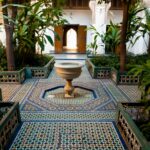
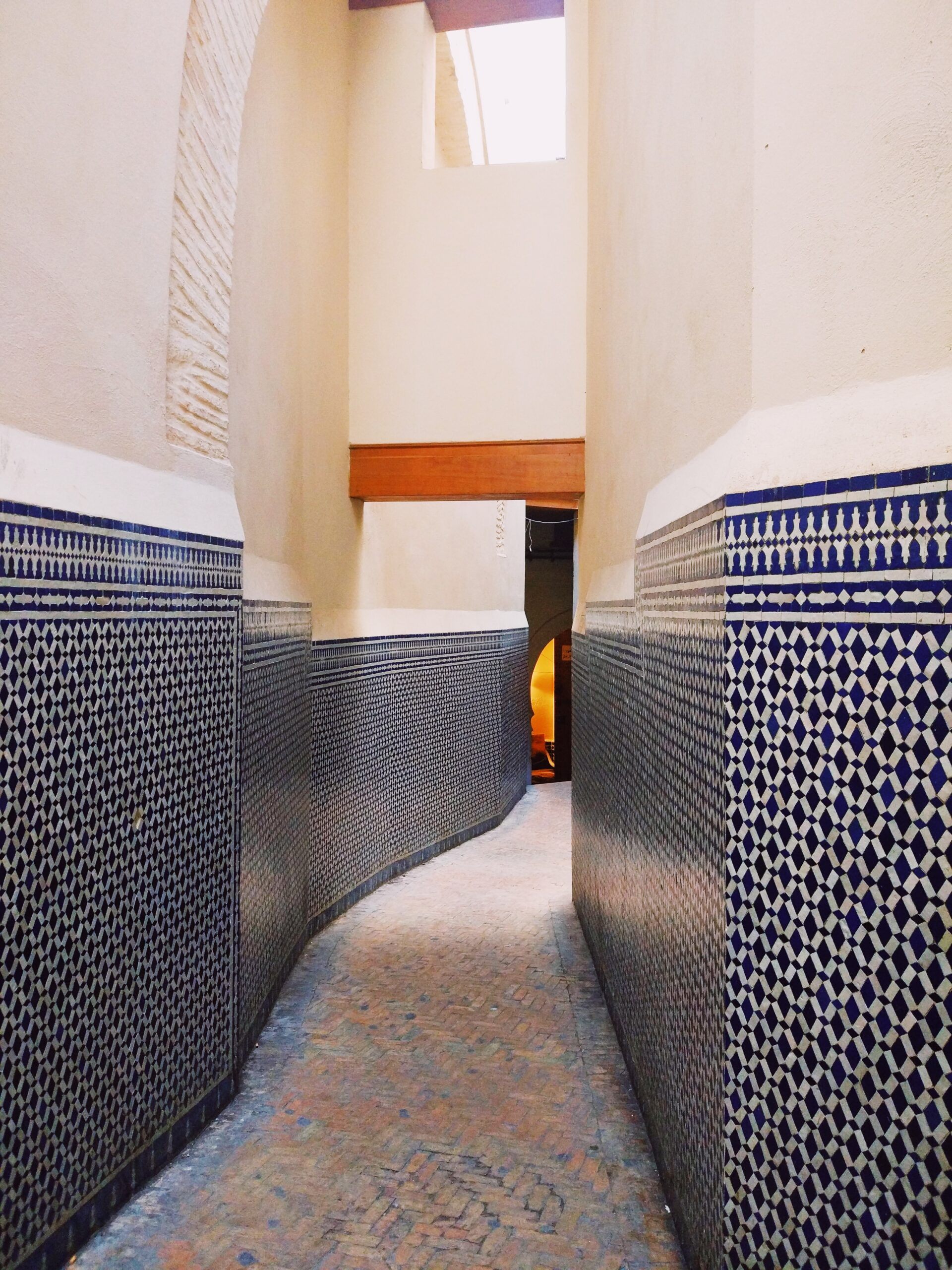
Zellij transforms the surface of architecture into a field of proportion, repetition, rhythm, and mathematical order. The pattern establishes scale and continuity while articulating walls, fountains, floors, columns, staircases, and thresholds.
The geometry is not simply something to look at.
It creates relationships.
A zellij composition can visually connect floor and wall, interior and exterior, water and architecture, shadow and light. Its repetition produces a sense of continuity while its complexity creates moments of visual discovery.
The surface becomes spatial.
This is one of the fundamental characteristics of Moroccan architectural language: the boundary between two-dimensional decoration and three-dimensional architecture becomes remarkably fluid.
The wall is simultaneously structure, surface, pattern, atmosphere, and cultural memory.
Ornament as a Measure of Space
Moroccan decoration also operates as a sophisticated system of scale.
A large courtyard can feel intimate because its surfaces are divided into carefully controlled geometric fields. A monumental entrance can become human in scale through repetitive craftsmanship. A corridor can acquire depth through successive patterns, shadows, arches, and thresholds.
Decoration therefore helps the observer understand the dimensions of space.
This is particularly important in architecture where the experience is often sequential rather than instantaneous.
One does not necessarily perceive the entire building at once.
Instead, architecture is revealed through movement:
entrance → threshold → passage → courtyard → gallery → room → garden.
Each transition introduces a different proportion, texture, light condition, or pattern.
The decorative language becomes a form of spatial punctuation.
It tells us when one architectural condition ends and another begins.
Carved Plaster: The Wall as a Living Surface
The Moroccan tradition of geometric and vegetal plaster carving offers another profound example.
Sculpted plaster does not simply decorate a wall. It transforms the wall into an intermediary between architecture and light.
Relief creates shadow.
Shadow creates depth.
Depth changes throughout the day.
As sunlight moves across a carved surface, the architecture continuously changes. The same wall can appear different in the morning, at midday, and in the evening.
In this sense, ornament becomes temporal architecture.
The surface records the movement of light.
This is one reason traditional Moroccan interiors can possess such extraordinary atmospheric richness without relying on large quantities of furniture, colour, or visual objects.
The architecture itself is producing the experience.
Cedarwood: Structure, Craft and Atmosphere
The same principle can be observed in Moroccan cedarwood architecture.
Carved and painted wooden ceilings, doors, screens, beams, and architectural elements occupy a position somewhere between structure, craftsmanship, and decoration.
The material communicates construction while simultaneously expressing cultural identity.
The grain of the wood, the rhythm of beams, the painted geometric compositions, and the craftsmanship of the joints contribute to a unified architectural vocabulary.
The result is not simply “decorated wood.”
It is wood transformed into architecture through craft.
This distinction is essential.
Traditional Moroccan craftsmanship often refuses the contemporary separation between architect, designer, artist, and artisan. Knowledge is distributed across disciplines, and the final architectural environment emerges from their interaction.
Tadelakt: Material as Architectural Identity
Even the apparently simple surfaces of tadelakt demonstrate this principle.
Its polished, mineral character creates a continuous surface that is simultaneously tactile, waterproof, luminous, and deeply connected to Moroccan building traditions.
In bathrooms, hammams, riads, fountains, and contemporary interiors, tadelakt does more than provide a finish.
It determines how light is reflected.
It determines how the hand experiences the wall.
It determines how colour behaves across a curved surface.
It creates visual continuity between architectural elements.
The material itself becomes part of the aesthetic language.
Here again, decoration is not an additional layer.
Material becomes meaning.
The Moroccan Arch Is Not Simply Decorative
Even the characteristic Moroccan arch should not be understood exclusively as a decorative motif.
Arches define thresholds, frame views, establish rhythm, create transitions, and organize movement.
The repeated appearance of arches throughout a riad, palace, mosque, madrasa, or contemporary interpretation of Moroccan architecture creates a visual grammar.
One arch establishes an opening.
A sequence of arches establishes rhythm.
A succession of rhythms establishes spatial identity.
Architecture begins to behave almost like music.
This is perhaps the most useful way to understand Moroccan ornament: not as isolated decoration, but as syntax.
Light Is the Final Material
Moroccan architecture is particularly sophisticated in its manipulation of light.
The traditional building often avoids excessive exposure to the exterior and instead creates carefully controlled relationships between shadow and illumination.
Small openings, courtyards, mashrabiya-like screens, arcades, carved surfaces, and deep reveals produce a constantly changing environment.
Decoration intensifies this phenomenon.
A carved surface captures shadow.
A zellij surface reflects light.
A polished plaster wall diffuses it.
A fountain introduces movement and reflection.
A wooden screen filters it.
The decorative language therefore participates directly in the architecture’s optical performance.
What appears ornamental becomes an instrument for designing light.
Pattern as Cultural Memory
There is also a deeper dimension.
Moroccan geometric patterns are not simply aesthetic compositions. They belong to a long intellectual and artistic tradition in which geometry represents order, proportion, repetition, balance, and continuity.
The pattern can connect contemporary architecture with centuries of accumulated knowledge.
This is why Moroccan decoration can carry an extraordinary sense of cultural depth.
A geometric composition on a wall may appear contemporary, but its underlying principles belong to a much older architectural culture.
The surface becomes a form of collective memory.
Ornament and the Concept of Luxury
This distinction is particularly relevant to contemporary luxury architecture.
Luxury is often associated with expensive materials, large dimensions, minimal interiors, or spectacular visual statements.
The Moroccan architectural tradition proposes another definition.
Luxury can be found in precision.
In the quality of a handmade zellij composition.
In the subtle variation of a plaster surface.
In the proportion of a courtyard.
In the craftsmanship of a cedar door.
In the controlled transition from shadow to light.
In the sound of water.
In the tactile quality of a wall.
This is a quieter and more sophisticated form of luxury.
It is not necessarily about abundance.
It is about depth, material intelligence, craftsmanship, and atmosphere.
Moroccan Architecture and Contemporary Minimalism
This becomes particularly interesting when Moroccan architecture is placed within today’s dialogue between minimalism and maximalism.
At first glance, traditional Moroccan architecture may appear maximalist because of its patterns, colours, craftsmanship, and material richness.
But this interpretation is misleading.
Beneath the visual richness is often an extremely disciplined architectural order.
Courtyards are proportioned carefully.
Geometry is rigorously controlled.
Materials are limited and coherent.
Colour relationships are intentional.
Light is carefully orchestrated.
Movement follows a clear spatial hierarchy.
In this sense, Moroccan architecture can be visually rich yet conceptually restrained.
It demonstrates that minimalism does not necessarily require visual emptiness.
A space can contain extraordinary complexity while remaining fundamentally ordered.
This is one of the most valuable lessons Moroccan architecture can offer contemporary designers.
From Ornament to Integrated Architectural Language
The most sophisticated contemporary interpretation of Moroccan architecture should therefore avoid simply copying traditional motifs.
Applying zellij to a contemporary building does not automatically make the architecture Moroccan.
Painting geometric patterns onto a wall does not necessarily create Moroccan architecture.
True architectural interpretation requires understanding the principles beneath the visible vocabulary:
proportion, privacy, climate, materiality, geometry, craftsmanship, light, water, threshold, rhythm, and human experience.
The objective is not to reproduce the past.
It is to understand the intelligence of the past well enough to create something relevant to the present.
This is where Moroccan architecture becomes particularly powerful for contemporary architects and interior designers.
Its greatest contribution may not be its motifs.
It may be its ability to demonstrate that decoration, when deeply integrated with material, geometry, light, and spatial organization, can become a form of architectural intelligence.
Conclusion: When Ornament Becomes Structure
The question, therefore, should perhaps not be:
“Does Moroccan architecture use ornament?”
The more interesting question is:
“Where does architecture end and ornament begin?”
In the traditional Moroccan context, the answer is often: they do not have a clear boundary.
Zellij is surface, geometry, craft, and spatial rhythm.
Carved plaster is wall, relief, shadow, and light.
Cedarwood is material, structure, craftsmanship, and identity.
Water is cooling device, visual element, acoustic presence, and spiritual symbol.
The courtyard is climate strategy, social space, garden, and architectural centre.
What we call “decoration” is therefore frequently performing architectural work.
Moroccan architecture reminds us that ornament does not necessarily mean excess.
It can mean precision.
It can mean memory.
It can mean material intelligence.
It can mean light made visible.
And, at its highest level, it can mean architecture communicating through a language richer than structure alone.
Moroccan decoration is not simply something placed upon architecture. It is one of the ways architecture thinks, speaks, and is experienced.