Calligraphy occupies a central and profoundly symbolic role in Moroccan architecture and design, where writing transcends language to become structure, ornament, and spiritual expression. Rooted in Islamic civilization, Moroccan calligraphy is inseparable from architecture; it shapes space, guides the eye, and conveys meaning through rhythm, proportion, and harmony. More than decoration, it is a visual philosophy that unites faith, craftsmanship, and aesthetics.
In Moroccan architectural composition, calligraphy is most commonly rendered in Kufic and Maghrebi scripts. Kufic, with its strong geometry and angular discipline, lends itself naturally to architectural integration. It appears carved in stone, molded in stucco, or assembled in zellij tilework, often forming continuous bands that frame walls, arches, and courtyards. Maghrebi script, flowing and rounded, brings movement and elegance, particularly in wooden elements, painted ceilings, and manuscript-inspired decorative panels. Each script is chosen not only for its readability but for its visual balance within architectural proportions.
Calligraphy in Moroccan design is inseparably linked to sacred texts and poetic expressions. Qur’anic verses, invocations, blessings, and aphorisms are carefully selected to resonate with the function of the space. In mosques and madrasas, inscriptions emphasize divine unity, knowledge, and contemplation. In palaces, riads, and traditional houses, calligraphy often conveys prosperity, protection, and refinement. The placement of text is never arbitrary; inscriptions are positioned at eye level, along cornices, or within architectural frames to create a dialogue between space, light, and meaning.
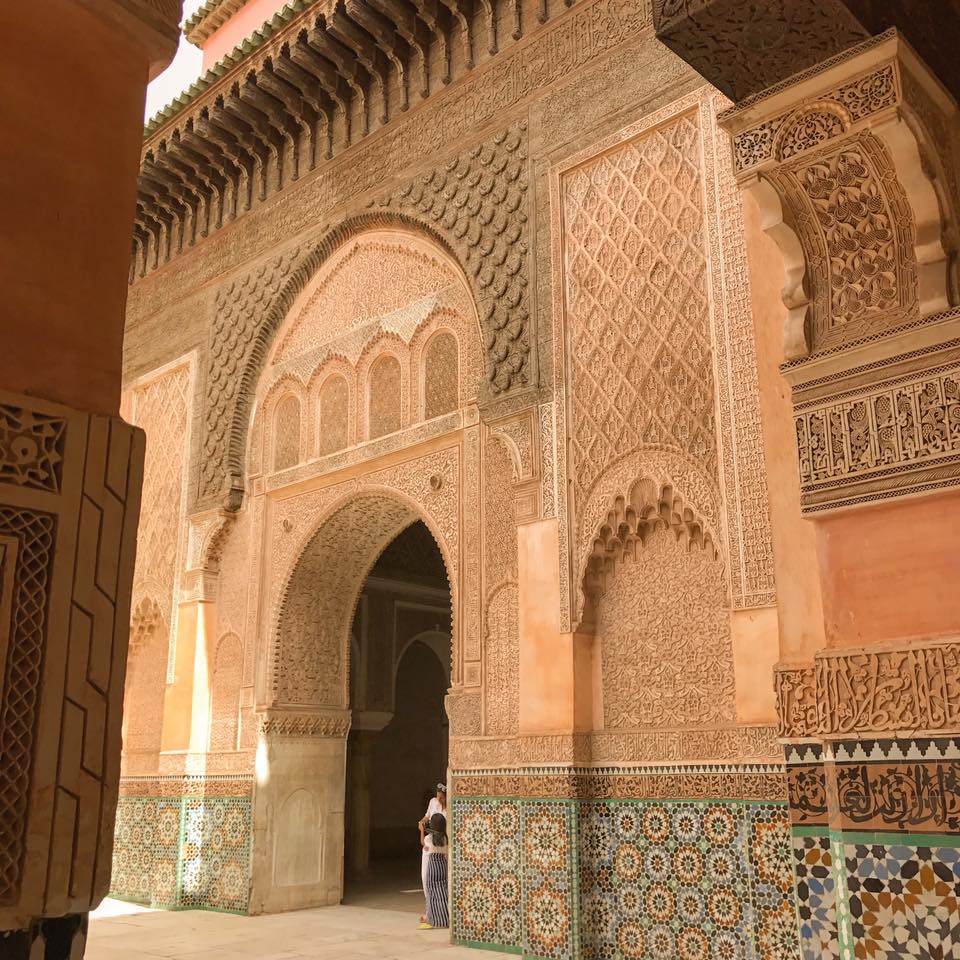
One of the most refined expressions of calligraphic composition appears in carved stucco. Moroccan artisans sculpt calligraphy in high and low relief, creating delicate shadows that evolve throughout the day. The inscriptions flow seamlessly into arabesque motifs and geometric patterns, forming a unified decorative language. Here, calligraphy does not dominate; it harmonizes with vegetal and geometric elements, reflecting the Islamic principle of unity through diversity.
Zellij tilework offers another sophisticated medium for calligraphic design. Using glazed terracotta tiles cut by hand, artisans compose Kufic inscriptions with mathematical precision. The interplay between text, color, and geometry transforms calligraphy into architectural structure. These compositions are particularly striking in fountains, mihrabs, and monumental entrances, where water, light, and inscription converge to create a contemplative atmosphere.
Woodwork further demonstrates the versatility of Moroccan calligraphy. In carved cedar doors, ceilings, and minbars, inscriptions are integrated into complex geometric frameworks. The warmth of wood softens the visual impact of the text, emphasizing craftsmanship and intimacy. Painted calligraphy on wood, often enhanced with natural pigments and gold, reflects Andalusian influence and the deep connection between Moroccan architecture and manuscript art.
Beyond its aesthetic value, calligraphy in Moroccan architecture embodies intellectual and spiritual ideals. The act of reading becomes a form of movement through space, inviting reflection and mindfulness. The repetition of phrases and the continuity of inscriptions reinforce the concept of infinity, a fundamental principle in Islamic art. Architecture thus becomes a vessel for knowledge, memory, and transmission across generations.
In contemporary Moroccan design, calligraphic composition continues to inspire architects and designers. Modern interpretations reinterpret traditional scripts through minimalist forms, abstract layouts, and innovative materials, while respecting historical principles of proportion and symbolism. This continuity ensures that calligraphy remains a living art, deeply anchored in heritage yet open to creative evolution.
In essence, calligraphic composition in Moroccan architecture and design represents a refined synthesis of art, language, and space. It transforms buildings into texts to be read and experienced, where every inscription contributes to a larger narrative of beauty, spirituality, and cultural identity.