The Evolution of Moroccan Architectural Identity
Introduction: Architecture as the Mirror of Civilization
Architecture is perhaps the most enduring expression of a civilization. Unlike paintings or literature, buildings become permanent witnesses to history, preserving the political ambitions, social structures, technological knowledge, religious beliefs, and artistic ideals of the people who created them.
Few countries demonstrate this relationship between architecture and identity as profoundly as Morocco. Standing at the crossroads of Africa, Europe, and the Middle East, Morocco has spent more than twelve centuries absorbing, adapting, and reinventing influences from Amazigh (Berber), Arab, Andalusian, African, Ottoman, Mediterranean, and European cultures.
The Moroccan architectural landscape is therefore not a collection of isolated monuments but a continuous narrative. Each era contributed a new chapter while respecting what came before.
The journey from the monumental kasbah to today’s luxury contemporary villas illustrates one of the most fascinating architectural evolutions in the world. Rather than abandoning its heritage, Morocco has consistently transformed it, allowing ancient principles to coexist with modern innovation.
Today, many of Morocco’s finest contemporary homes still owe their spatial philosophy to the medieval kasbah.
1. The Kasbah: Fortress, Palace and Symbol of Authority
The story begins with the kasbah.
The word “Kasbah” derives from the Arabic Qasaba, meaning fortress or citadel.
In Morocco, however, the kasbah evolved into something far richer than a military structure.
It represented:
- political authority
- tribal protection
- economic power
- architectural mastery
- environmental adaptation
Most kasbahs were constructed between the 11th and 19th centuries throughout southern Morocco, particularly in the High Atlas, Anti-Atlas and Draa Valley.
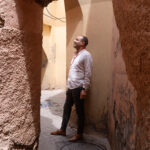
Unlike European castles built of stone, Moroccan kasbahs emerged directly from the landscape.
Their reddish walls blended almost perfectly with surrounding mountains and desert.
This visual integration was intentional.
The architecture respected the land rather than dominating it.
Earth Architecture: Intelligence Before Technology
Kasbahs were primarily built from:
- rammed earth (pisé)
- adobe bricks
- straw
- clay
- palm wood
- cedar beams
Today these materials are often described as “sustainable.”
Yet centuries before sustainability became fashionable, Moroccan builders understood how local materials could naturally regulate indoor temperatures.
Massive earth walls often exceeded one meter in thickness.
These walls absorbed heat during the day and slowly released it at night.
Without electricity, insulation, or mechanical systems, interiors remained remarkably comfortable.
Modern environmental engineers now study these same passive cooling principles.
2. Architecture Designed Around Community
Unlike European fortresses focused solely on defense, Moroccan kasbahs functioned as complete living environments.
Within their walls existed:
- private residences
- granaries
- kitchens
- workshops
- gardens
- mosques
- stables
- water systems
Architecture organized society.
Every courtyard encouraged interaction.
Every terrace became social space.
Every passage reflected hierarchy.
The kasbah was essentially a miniature city.
Its architecture balanced collective life with individual privacy.
3. The Amazigh Foundation
Although many kasbahs were commissioned by powerful dynasties, their construction techniques originated largely from Amazigh building traditions.
The Amazigh worldview viewed architecture as an extension of nature rather than an object imposed upon it.
Several principles emerged:
Building with the Landscape
Rather than flatten hillsides, buildings followed natural topography.
Climate Before Appearance
Orientation considered:
- prevailing winds
- solar exposure
- seasonal temperatures
Collective Construction
Entire communities participated in construction.
Architecture became a shared cultural act.
Knowledge passed orally from master builders to younger generations.
4. The Arrival of Islamic Urbanism
Beginning in the 8th century, Islamic civilization transformed Moroccan cities.
Urban planning introduced:
- geometric order
- neighborhood organization
- religious orientation
- water management
- privacy principles
Cities such as Marrakech, Fez, Meknes, and Rabat became masterpieces of Islamic urban design.
Architecture shifted from defensive landscapes toward highly organized urban environments.
The focus moved inward.
5. The Birth of the Riad
Perhaps no architectural invention better defines Moroccan domestic architecture than the riad.
Unlike the imposing exterior of a kasbah, the riad concealed its beauty behind modest walls.
This represented an entirely different architectural philosophy.
The exterior communicated humility.
The interior celebrated refinement.
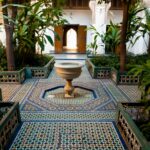
The central courtyard became:
- environmental regulator
- spiritual center
- family gathering place
- source of light
- ventilation system
Nature entered architecture.
Water became architecture.
Light became architecture.
Silence became architecture.
6. Andalusian Influence: The Architecture of Beauty
Following the fall of Muslim Spain, thousands of artisans, architects, and scholars settled in Morocco.
They introduced extraordinary craftsmanship:
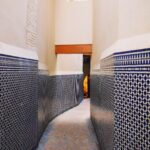
Zellij
Complex mathematical mosaics expressing infinity.
Carved Cedar
Highly detailed vegetal ornament.
Stucco Sculpture
Intricate geometric and floral compositions.
Horseshoe Arches
Graceful transitions between spaces.
Muqarnas
Three-dimensional sculptural ceilings creating visual movement.
Moroccan architecture became increasingly sophisticated.
Decoration evolved into intellectual expression.
Geometry reflected divine perfection.
7. The Palace Era
Under the Saadian and Alaouite dynasties, architecture reached unprecedented refinement.
Royal palaces combined:
- monumental scale
- intimate courtyards
- ceremonial spaces
- gardens
- fountains
- luxurious materials
Yet despite increased grandeur, the essential principles remained unchanged:
privacy,
shade,
water,
symmetry,
craftsmanship,
and human scale.
8. Colonial Morocco: A New Architectural Language
The French Protectorate (1912–1956) marked one of the most significant turning points in Moroccan architectural history.
European planners introduced:
- wide boulevards
- Art Deco
- Modernism
- reinforced concrete
- steel structures
- new infrastructure
Rather than destroying the historic medinas, urban planner Henri Prost promoted a dual-city model: preserving traditional urban fabric while developing modern districts such as Gueliz in Marrakech and Ville Nouvelle in other cities.
This period fostered a dialogue between Moroccan craftsmanship and European planning principles.
9. Independence and the Search for Identity
After independence in 1956, Moroccan architects faced a fundamental question:
How can Morocco modernize without losing its architectural soul?
Some embraced international modernism.
Others sought inspiration from traditional forms.
This debate continues today.
The most successful architects discovered that modernity and heritage are not opposites.
They are complementary.
10. The Contemporary Moroccan Villa
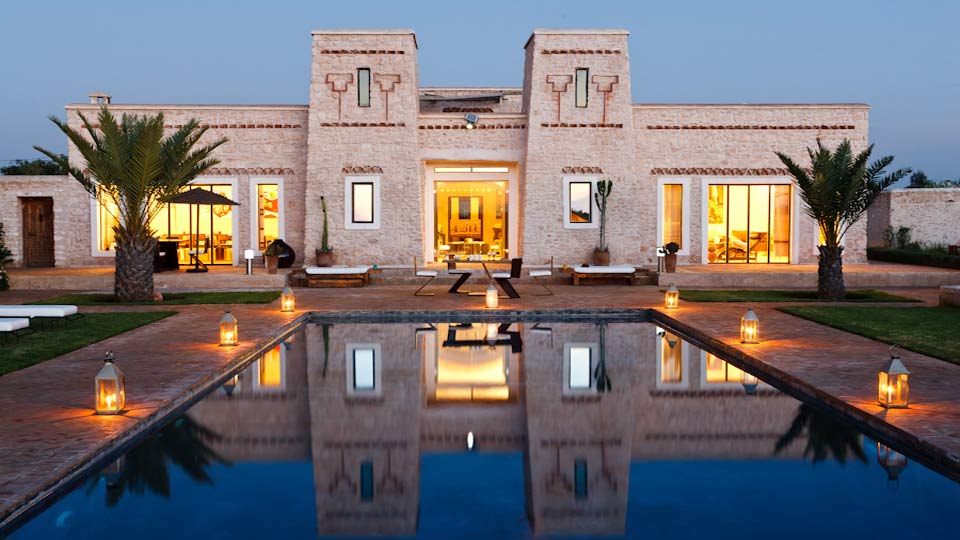
Today’s finest Moroccan villas represent centuries of accumulated architectural knowledge.
Although visually contemporary, they inherit countless principles from the kasbah and riad.
Open Spatial Planning
Walls disappear.
Living areas flow together.
Yet privacy remains carefully orchestrated.
Courtyards Reimagined
Internal gardens continue providing:
- daylight
- ventilation
- tranquility
- connection with nature
Indoor–Outdoor Living
Large openings dissolve boundaries between architecture and landscape.
Gardens become living rooms.
Terraces become dining spaces.
Pools reinterpret traditional fountains.
Natural Materials Return
Stone.
Earth.
Lime plaster.
Tadelakt.
Walnut.
Cedar.
Brass.
Handmade zellij.
These materials reconnect modern architecture with Moroccan craftsmanship.
11. The Renaissance of Craftsmanship
One of the most remarkable developments in contemporary Morocco is the renewed appreciation for traditional artisans.
Architects increasingly collaborate with:
- master zellij craftsmen
- wood carvers
- plaster sculptors
- blacksmiths
- tadelakt specialists
- weavers
- ceramic artists
Luxury architecture increasingly values handmade work over industrial production.
This is not nostalgia.
It is cultural continuity.
12. Sustainability: Ancient Wisdom Meets Modern Technology
Ironically, many concepts celebrated in contemporary sustainable architecture have existed in Morocco for centuries.
Traditional Moroccan architecture already mastered:
Passive cooling.
Natural ventilation.
Thermal mass.
Water conservation.
Local materials.
Solar orientation.
Minimal environmental impact.
Modern architects now combine these principles with:
- solar energy
- smart home technology
- high-performance glazing
- rainwater harvesting
- geothermal systems
- advanced insulation
The result is architecture that is both environmentally responsible and culturally rooted.
13. Luxury Redefined
Luxury in Morocco has undergone a profound transformation.
Historically, wealth was expressed through ornamentation and craftsmanship.
Today, luxury increasingly emphasizes:
- space
- natural light
- craftsmanship
- authenticity
- silence
- privacy
- environmental quality
- timeless design
A contemporary Moroccan villa may feature minimalist architecture while incorporating handcrafted zellij, sculpted plaster, carved cedar, and a tranquil courtyard inspired by centuries-old traditions.
This fusion creates spaces that are both modern and unmistakably Moroccan.
14. Global Recognition of Moroccan Design
In recent decades, Moroccan architecture has gained international acclaim for its ability to merge heritage with innovation.
Leading architects and designers from around the world draw inspiration from Morocco’s mastery of proportion, materiality, light, and craftsmanship. Moroccan design influences luxury hotels, private residences, and boutique hospitality projects across Europe, the Middle East, the Americas, and Asia. Its enduring appeal lies not in imitation of historical styles, but in the reinterpretation of timeless principles that remain relevant to contemporary living.
15. The Future of Moroccan Architectural Identity
The future of Moroccan architecture is unlikely to be defined by radical breaks with tradition.
Instead, it will continue the long-standing Moroccan practice of synthesis.
Emerging trends include:
- ecological construction using stabilized earth and lime
- adaptive reuse of historic riads and kasbahs
- digitally fabricated components paired with handcrafted finishes
- smart-home technologies integrated into traditional spatial layouts
- regenerative landscaping suited to arid climates
- renewed investment in local materials and artisanal expertise
The challenge for future architects will not be whether to choose between tradition and innovation, but how to weave them together in ways that remain authentic, sustainable, and responsive to contemporary life.
Conclusion: A Living Architectural Heritage
The evolution from the kasbah to the contemporary villa is far more than a stylistic progression. It is the story of a civilization that has continuously adapted while preserving its core values.
The fortified kasbah expressed security, collective life, and harmony with the landscape. The inward-looking riad introduced privacy, serenity, and a poetic relationship between architecture, light, water, and nature. Palaces elevated craftsmanship to an art form, while the colonial period introduced new technologies and urban planning concepts. Contemporary villas now integrate these inherited principles with modern engineering, sustainability, and global design influences.
Throughout every transformation, Moroccan architecture has retained a remarkable continuity. It continues to prioritize climate-responsive design, human-scaled spaces, artisanal excellence, and a profound respect for place. Rather than viewing history as a constraint, Moroccan architects have consistently treated it as a source of inspiration.
Ultimately, the Moroccan architectural identity is not defined by a single style or historical period. It is defined by its extraordinary capacity to evolve without forgetting its origins. From the earthen walls of the kasbah to the refined lines of the contemporary villa, Moroccan architecture remains a living tradition—one that continues to shape how people experience beauty, community, and the relationship between the built environment and the natural world.