Marrakech is a city where architecture transcends function to become a powerful expression of identity, memory, and artistry. Since its foundation in 1062 by the Almoravids, the city has evolved as a major cultural and architectural capital of the Islamic West, shaped by successive dynasties—the Almoravids, Almohads, Saadians, and Alaouites—each leaving a distinctive yet harmonious imprint. The resulting urban fabric is a refined synthesis of Amazigh building knowledge, Andalusian aesthetics, Saharan pragmatism, and Islamic philosophy, creating an architectural language that is both deeply rooted and remarkably timeless.
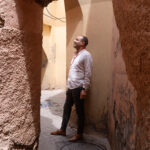
At the heart of Marrakech lies its medina, a masterpiece of urban planning adapted to climate, social structure, and spiritual life. Enclosed by imposing rammed-earth walls stretching nearly 19 kilometers, the medina is designed as an organic city, where narrow, shaded streets regulate temperature and encourage human interaction. This dense urban network leads to mosques, madrasas, fountains, hammams, and souks, forming a cohesive architectural ecosystem. Buildings are outwardly modest, often with plain façades, reflecting values of humility and discretion, while their interiors reveal extraordinary richness and refinement.
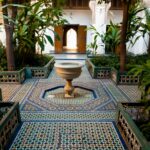
The riad is the most emblematic architectural typology of Marrakech. Organized around a central courtyard, often with a fountain or garden, the riad embodies the Islamic concept of paradise on earth. Water, vegetation, light, and geometry interact to create a serene microclimate and a space for contemplation. The decorative arts reach their highest expression here: hand-cut zellij tiles assembled in complex geometric patterns; sculpted plaster carved with vegetal motifs and Quranic inscriptions; and finely carved cedar wood ceilings from the Middle Atlas. These elements are not mere decoration but a visual language governed by mathematical precision and spiritual symbolism.
Monumental architecture defines Marrakech’s historical authority and spiritual depth. The Koutoubia Mosque remains the city’s most iconic landmark, its minaret a masterpiece of Almohad architecture and a symbol of balance, proportion, and unity. Its design influenced major monuments such as the Giralda in Seville and the Hassan Tower in Rabat, underscoring Marrakech’s historical role as a center of architectural innovation. Other mosques, including Ben Youssef Mosque, contribute to the city’s sacred geography, while the adjacent Ben Youssef Madrasa stands as one of the finest examples of Islamic educational architecture in North Africa, where architecture serves both knowledge and devotion.
Royal architecture further elevates Marrakech’s status as an architectural jewel. The El Badi Palace, now a poetic ruin, once showcased the wealth and ambition of the Saadian dynasty through Italian marble, gold, and vast ceremonial spaces. In contrast, the Bahia Palace offers a more intimate yet equally sophisticated vision of power, with its harmonious proportions, light-filled courtyards, and exquisite craftsmanship. These palaces demonstrate how Moroccan architecture balances grandeur with human scale, and authority with aesthetic sensitivity.
Materials and construction techniques are central to Marrakech’s architectural identity. Rammed earth (pisé), adobe, and lime plaster reflect a deep understanding of local resources and environmental conditions. These sustainable methods, refined over centuries, provide thermal comfort while blending seamlessly with the city’s ochre landscape, earning Marrakech its poetic title, The Red City. Architecture here is inseparable from nature, responding intelligently to light, heat, and time.
Beyond its historic walls, Marrakech reveals another architectural chapter. The Guéliz and Hivernage districts, developed during the early 20th century, introduce Art Deco, modernist, and Bauhaus-inspired buildings, enriched by Moroccan decorative details. Today, contemporary architecture in Marrakech continues this dialogue, as architects and designers reinterpret traditional forms through minimalist aesthetics, ecological principles, and artisanal collaboration. Luxury hotels, private villas, and cultural institutions draw inspiration from riads and kasbahs, proving the enduring relevance of Moroccan architectural wisdom.
Ultimately, Marrakech is not a static museum but a living architectural landscape. Its buildings are inhabited, adapted, and transmitted through generations of master craftsmen—maalems—whose knowledge preserves the soul of the city. Marrakech’s architecture offers more than visual beauty; it conveys a philosophy of life centered on balance, inward reflection, community, and respect for heritage. As an architectural jewel, Marrakech stands as a profound testament to the power of place, craftsmanship, and cultural continuity, captivating architects, historians, artists, and travelers seeking meaning beyond form.