Moroccan carved stucco—known locally as gebs—is one of the most emblematic and refined elements of Moroccan and Moorish architecture. This intricate decorative art, which adorns palaces, madrasas, riads, and mosques, represents a centuries-old tradition where craftsmanship, mathematics, spirituality, and aesthetics converge seamlessly. Its mastery reflects the creative genius of Moroccan artisans who transformed simple plaster into poetry carved in stone-like relief.
Historical Origins and Evolution
The origins of carved stucco in Morocco date back to the Almoravid dynasty (11th–12th centuries), when Islamic aesthetics began to take deep root across North Africa. However, it reached its full artistic expression under the Almohads, and later flourished spectacularly during the Marinid, Saadian, and Alaouite dynasties. Influenced by Andalusian, Eastern Islamic, and indigenous Amazigh traditions, Moroccan stucco became a sophisticated visual language that conveyed harmony, balance, and spirituality. Throughout the imperial cities of Fez, Marrakech, Meknes, and Rabat, carved stucco emerged as a defining feature of sacred and secular architecture alike.
Materials and Composition
Traditionally, Moroccan stucco is crafted from a fine mixture of gypsum plaster, lime, water, and natural binders. Artisans refine the mixture repeatedly to achieve a soft, malleable texture capable of capturing extremely delicate detail. Once applied to walls, arches, or friezes, the surface is left to partially dry until it reaches the perfect consistency for carving—a crucial stage that demands precision and decades of experience.
Techniques and The Craft of the Maâlems
The creation of carved stucco is a carefully orchestrated process guided by master craftsmen, or maâlems. After preparing the base layer, artisans sketch geometric structures or calligraphic grids directly onto the surface. Using a set of small chisels, knives, and fine metal tools, they begin carving with remarkable patience, working millimeter by millimeter.
This technique, known as carving in situ, allows for crisp lines, deep reliefs, and textures that cannot be achieved through prefabricated molds. Many artisans follow ancestral geometric ratios and secret workshop methods passed down through generations. A single decorative panel may require weeks or months of meticulous work.
Geometric, Floral, and Calligraphic Motifs
Carved stucco is celebrated for its symbolic richness and visual complexity. Its motifs fall into three main categories:
• Geometric Patterns
Built on principles of Islamic geometry, these motifs reflect mathematical precision and spiritual unity. Artisans create star polygons, interlacing bands, and radiating forms symbolizing infinity and divine order. The geometric language establishes harmony between architecture and the metaphysical world.
• Arabesques and Floral Designs
Inspired by vegetation, vines, and stylized flowers, these patterns add a sense of movement and vitality to architectural spaces. Their flowing lines contrast beautifully with the strict geometry, evoking the Islamic garden as a metaphor for paradise.
• Arabic Calligraphy
Verses from the Qur’an, poetic inscriptions, blessings, and royal dedications are commonly integrated into stucco compositions. Written in Kufic, Maghrebi, or Thuluth script, calligraphy reinforces the sacred and intellectual dimension of the space.
Symbolism and Aesthetic Philosophy
Moroccan stucco is more than decoration; it is a visual expression of Islamic philosophy, where abstraction replaces figurative representation. Its repeated patterns evoke the infinite nature of creation, celebrating divine perfection and the unity of all existence. Through symmetry, rhythm, and mathematical harmony, stucco transforms architecture into a spiritual journey—guiding visitors through light, shadow, and depth.
Architectural Contexts
Carved stucco plays an essential role in defining the character of Moroccan architecture. It is commonly found in:
- Mosques and Madrasas: decorating mihrabs, minbars, prayer halls, and scholarly courtyards.
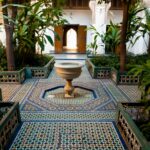
- Palaces and Riads: embellishing courtyards, reception rooms, and grand halls.
- Mausoleums: framing sanctuaries with delicate layers of decorative relief.
- Fortified Gates and Monumental Entrances: enriching façades with ceremonial grandeur.
Iconic examples include the Ben Youssef Madrasa and Bahia Palace in Marrakech, the Bou Inania Madrasa and Al-Attarine Madrasa in Fez, the Kasbah Mosque, and the Saadian Tombs, each showcasing masterpieces of stucco artistry.
Preservation, Continuity, and Modern Adaptation
While carved stucco remains a cornerstone of traditional Moroccan architecture, preserving this fragile art form is an ongoing challenge. Climate, humidity, and time threaten its delicate surfaces, requiring specialized restoration by trained maâlems.
Despite modern construction techniques, Moroccan stucco continues to inspire contemporary architects and designers. Today, it appears in luxury hotels, cultural centers, private villas, and heritage restorations, bridging the past and present while keeping ancient craftsmanship alive.
Moroccan carved stucco is not merely a decorative element—it is a profound artistic heritage that embodies the identity, spirituality, and craftsmanship of Morocco. Combining meticulous technique, architectural elegance, and centuries of cultural knowledge, it stands as one of the most remarkable achievements of Islamic art. Whether found in a grand palace or a traditional riad, its intricate patterns continue to inspire admiration and awe, revealing the timeless beauty of Moroccan architectural tradition.