Moroccan architecture is one of the world’s most sophisticated architectural traditions, a living expression of more than twelve centuries of cultural exchange, artistic refinement, spiritual values, and environmental adaptation. Deeply rooted in history, it represents a remarkable synthesis of Amazigh (Berber), Arab, Andalusian, African, Mediterranean, and Islamic influences, creating a unique architectural language that continues to inspire architects, designers, historians, and travelers from around the globe.
A Civilization Shaped by Crossroads
Morocco’s strategic position at the meeting point of Africa, Europe, and the Arab world has played a defining role in the evolution of its architecture. Throughout history, successive civilizations and dynasties contributed layers of artistic and architectural knowledge that merged into a distinctive Moroccan identity.
The foundations of Moroccan architecture can be traced back to the indigenous Amazigh communities, whose building techniques were adapted to diverse landscapes ranging from the Atlas Mountains and the Sahara Desert to fertile valleys and coastal regions. Traditional earthen kasbahs, fortified villages (ksour), and mountain dwellings reflected a profound understanding of climate, geography, and sustainable construction long before modern environmental design became a global concern.
The Arrival of Islam and the Birth of a New Architectural Identity
The arrival of Islam in the 7th century marked a transformative period in Moroccan architectural history. New urban centers emerged, and architecture became closely linked to spiritual, social, and civic life.
The founding of the city of Fez in the 8th century established one of the most influential centers of Islamic learning and architecture in the Western Islamic world. Mosques, madrasas, fountains, gardens, caravanserais, and palaces became essential components of Moroccan cities, reflecting both religious values and urban sophistication.
Architectural design was guided by principles of harmony, geometry, proportion, and spirituality. Buildings were conceived not merely as physical structures but as environments designed to promote contemplation, privacy, beauty, and community.
The Andalusian Legacy
One of the most significant chapters in Moroccan architectural development came with the arrival of Muslim and Jewish refugees from Al-Andalus (Islamic Spain) following the Reconquista between the 13th and 15th centuries.
These communities brought exceptional craftsmanship, artistic traditions, and technical expertise that profoundly enriched Moroccan architecture. The influence of Andalusian design can still be admired in elegant courtyards, intricate stucco carvings, carved cedar wood ceilings, geometric mosaics, horseshoe arches, and lush garden layouts.
The fusion between Moroccan and Andalusian traditions produced some of the most refined architectural masterpieces in the Islamic world, particularly in cities such as Fez, Marrakech, Meknes, and Tetouan.
The Great Dynasties and Their Architectural Contributions
Moroccan architecture flourished under several powerful dynasties, each leaving a distinctive architectural legacy.
Almoravid Dynasty (11th–12th Century)
The Almoravids transformed Marrakech into a major political and cultural capital. They introduced sophisticated urban planning, monumental religious architecture, and advanced hydraulic systems. Their influence helped establish many of the aesthetic principles that would characterize Moroccan architecture for centuries.
Almohad Dynasty (12th–13th Century)
The Almohads emphasized monumental scale and architectural purity. Their legacy includes some of Morocco’s most iconic landmarks, characterized by powerful geometric forms, monumental minarets, and harmonious proportions.
Marinid Dynasty (13th–15th Century)
The Marinids are celebrated for their extraordinary educational architecture. They constructed magnificent madrasas adorned with breathtaking zellij tilework, carved plaster, and cedar wood craftsmanship. This period is often regarded as the golden age of Moroccan decorative arts.
Saadian and Alaouite Dynasties
The Saadian and Alaouite dynasties elevated architecture to new levels of refinement and luxury. Palaces, mausoleums, gardens, and royal residences combined exquisite craftsmanship with complex decorative programs that showcased Morocco’s artistic excellence.
The Language of Moroccan Architecture
What distinguishes Moroccan architecture is not only its history but also its highly symbolic design vocabulary.
Zellij: Geometry as Art
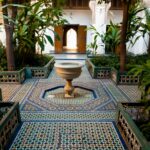
Moroccan zellij is among the most celebrated decorative arts in the world. Hand-cut geometric mosaics transform walls, floors, fountains, and courtyards into compositions of extraordinary complexity and beauty. More than decoration, zellij reflects mathematical precision, spiritual symbolism, and centuries of artisanal knowledge passed from master craftsmen to apprentices.
Carved Plaster and Cedar Wood
Intricate plasterwork and hand-carved cedar wood reveal the extraordinary skill of Moroccan artisans. Floral motifs, arabesques, calligraphy, and geometric patterns create visual richness while maintaining a sense of harmony and balance.
Courtyards and Riads
The traditional riad represents one of Morocco’s most ingenious architectural concepts. Organized around an interior garden or fountain, the riad creates a private oasis protected from the bustling streets outside. This inward-focused design reflects both climatic intelligence and cultural values centered on privacy, tranquility, and family life.
Gardens and Water
Water is a fundamental element of Moroccan architecture. Reflecting pools, fountains, channels, and gardens symbolize life, purity, and paradise. They also provide natural cooling systems perfectly adapted to Morocco’s warm climate.
Architecture Designed for Climate
Long before sustainability became a contemporary concern, Moroccan builders developed architectural solutions perfectly adapted to local environmental conditions.
Thick earthen walls regulate temperature, interior courtyards improve ventilation, shaded arcades reduce solar exposure, and carefully positioned openings encourage natural airflow. Traditional Moroccan architecture demonstrates a sophisticated understanding of passive cooling and ecological design principles that remain highly relevant to contemporary architecture.
Today, many architects and designers study these historical techniques as models for sustainable construction in hot climates.
Marrakech: A Living Architectural Museum
For visitors, few places illustrate the richness of Moroccan architectural history better than Marrakech. Founded in 1070, the city offers an extraordinary architectural journey through centuries of Moroccan history.
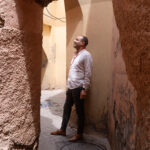
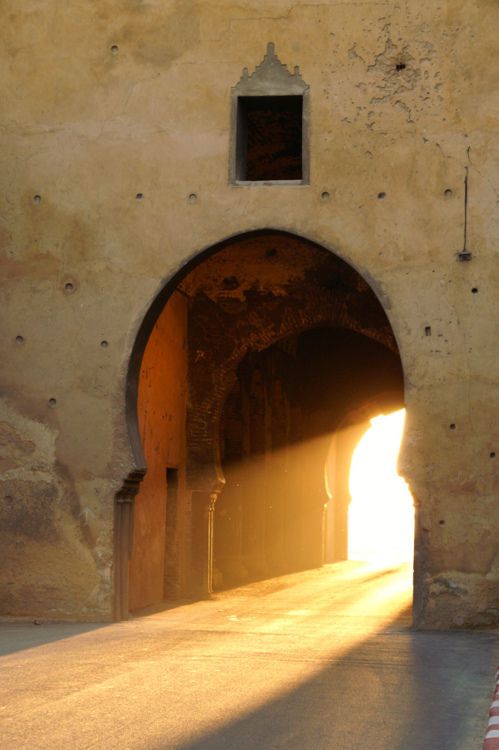
Within its historic medina, travelers encounter monumental gates, traditional riads, hidden courtyards, artisan workshops, palaces, gardens, mosques, and bustling souks. Every alleyway reveals layers of architectural history that continue to shape the city’s unique character.
For architects, designers, and cultural travelers, Marrakech is not simply a destination—it is an open-air laboratory where centuries of craftsmanship, urban planning, decorative arts, and architectural innovation remain remarkably alive.
A Timeless Heritage
Moroccan architecture is far more than a collection of beautiful buildings. It is a reflection of Morocco’s history, cultural diversity, artistic excellence, and enduring relationship with place. Its architectural heritage demonstrates how beauty, functionality, spirituality, and sustainability can coexist within a unified design philosophy.
For professionals in architecture and design, Morocco offers invaluable lessons in craftsmanship, materiality, climate-responsive construction, urban identity, and cultural continuity. For travelers, it provides a rare opportunity to experience an architectural tradition where every courtyard, mosaic, archway, and carved surface tells a story spanning more than a millennium of human creativity.