Traditional domestic architecture in Marrakech and across Morocco is a refined synthesis of craftsmanship, climate adaptation, spiritual symbolism, and social structure. It is not merely about building houses—it is about shaping environments that reflect identity, privacy, beauty, and harmony. The Moroccan home, especially the dar or riad, is a masterpiece of inward-focused design where every element—from walls to ornamentation—serves both functional and symbolic purposes.
1. The Philosophy of Moroccan Domestic Architecture
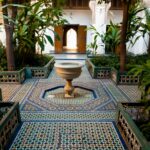
At the heart of Moroccan architecture lies the concept of interiority. Unlike Western homes that often open outward, traditional Moroccan houses are centered around an internal courtyard (riad), creating a private universe shielded from the outside world. This reflects deeply rooted cultural values of modesty, family intimacy, and protection from the harsh climate.
The architecture is shaped by influences from Al-Andalus, Amazigh traditions, and Islamic principles. Geometry, proportion, and repetition are not decorative excess—they are expressions of order and divine unity.
2. Traditional Construction Techniques
Earth-Based Construction (Pisé and Adobe)
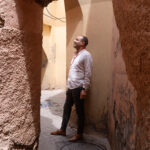
One of the oldest techniques is rammed earth (pisé), widely used in southern regions and medinas. Earth, water, and sometimes straw are compacted into thick walls.
Key advantages:
- Natural thermal insulation (cool in summer, warm in winter)
- Sustainable and locally sourced materials
- Durability when maintained
Adobe bricks (tabia) are also common, sun-dried and laid with mud mortar, forming thick, load-bearing walls.
Stone and Brick Masonry
In mountainous and urban areas, stone and baked bricks are used. These materials provide:
- Structural strength
- Resistance to weathering
- A base for refined decorative finishes
In cities like Fes, brick and stone construction is often combined with intricate surface decoration.
Lime Plaster (Tadelakt)
Tadelakt is one of Morocco’s most iconic finishes, originating from the region of Marrakech.
Characteristics:
- Waterproof and smooth
- Polished with stones and treated with black soap
- Used in hammams, bathrooms, fountains, and walls
Deep significance:
Tadelakt is not just a finish—it is a living surface, breathing with the building, reflecting light softly and creating a sensual, organic atmosphere.
Woodwork and Carpentry
Cedar wood, especially from the Middle Atlas, is extensively used.
Applications:
- Ceilings (zouaq) with painted geometric patterns
- Doors and mashrabiya-style screens
- Structural beams
The artistry reflects a mastery of geometry and color, often linked to Islamic art.
3. Decorative Techniques: A Language of Geometry and Symbolism
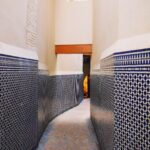
Zellij (Geometric Tilework)
Zellij is perhaps the most celebrated decorative art.
Technique:
- Hand-cut glazed tiles assembled into complex geometric patterns
- No use of figurative imagery, in respect of Islamic aesthetics
Symbolism:
- Infinite patterns → representation of the infinite nature of God
- Mathematical precision → harmony and cosmic order
Carved Plaster (Gypsum Stucco)
Plaster is carved into intricate floral and geometric motifs.
Features:
- Found around doors, windows, and arches
- Combines calligraphy, arabesques, and geometry
This technique transforms walls into delicate lace-like surfaces.
Calligraphy as Architecture
Arabic calligraphy is not simply written—it is sculpted into space.
Rooted in Islamic calligraphy, inscriptions often include:
- Quranic verses
- Blessings
- Poetry
Meaning:
The house becomes a spiritual text, where architecture speaks and protects.
Metalwork and Iron Craft
Hand-forged iron is used for:
- Window grilles
- Lanterns
- Door knockers
These elements combine security with artistic expression.
4. The Riad: A Masterpiece of Climate and Social Design
The traditional Moroccan house reaches its highest expression in the riad.
Core elements:
- Central courtyard with fountain or garden
- Symmetrical layout
- Rooms opening inward
Environmental intelligence:
- Natural ventilation through the courtyard
- Water and النباتات create microclimate cooling
- Thick walls regulate temperature
The riad is a silent oasis, an architectural response to both climate and culture.
5. Color, Light, and Material Harmony
Moroccan domestic spaces are carefully orchestrated:
- Earth tones from natural materials
- Vibrant tiles adding rhythm and contrast
- Filtered light through screens and courtyards
Light is not abundant—it is controlled, creating a play of shadow and illumination that enhances texture and depth.
6. Cultural and Social Dimensions
Architecture reflects Moroccan social structure:
- Separation of public and private spaces
- Emphasis on family life
- Hospitality expressed through decorated reception rooms (salons)
Every detail—from a carved door to a tiled floor—communicates status, taste, and cultural identity.
7. Continuity and Modern Reinterpretation
Today, traditional techniques are being revived in contemporary projects, especially in Marrakech. Artisans continue to practice ancestral crafts, preserving knowledge passed down through generations.
Modern architects reinterpret:
- Zellij in minimalist compositions
- Tadelakt in contemporary interiors
- Traditional layouts adapted for modern living
This continuity ensures that Moroccan architecture remains alive, not frozen in the past.
Conclusion
Traditional Moroccan domestic architecture is a profound dialogue between material, craft, spirituality, and environment. It is an architecture of intimacy and refinement, where every surface tells a story and every space serves a purpose beyond function.
It is not just built—it is crafted, shaped by human hands and guided by centuries of knowledge, making it one of the richest architectural traditions in the world.